VIKING’s ‘Helix’ System Reimagines High-Speed Evacuation for Passenger Ships
Evacuating hundreds of passengers in minutes is one of the toughest challenges at sea. A new system from VIKING Life-Saving Equipment aims to make that process faster, simpler, and far more controlled for both crew and passengers.
Designed for cruise ships and ferries, the Helix marine evacuation system (MES) introduces a fresh approach to mass evacuation under real-world conditions.
A New Take on Getting People Off the Ship—Fast
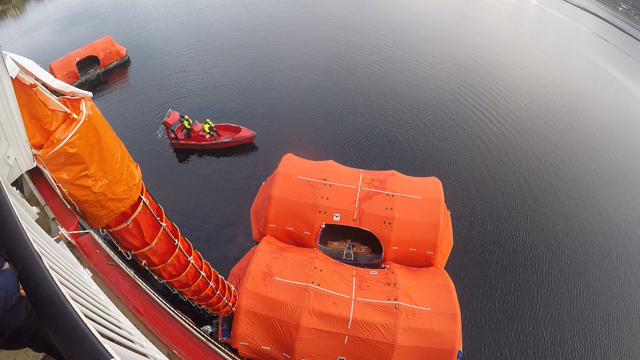
At the core of the Helix system is a spiral (helix-shaped) slide that allows multiple evacuees—between four and eight people—to descend simultaneously.
This significantly improves evacuation flow compared to traditional single-lane systems. The design also accommodates:
Passengers of all sizes Families evacuating together Injured persons on stretchers
In operational terms, the system can move up to 477 people within 30 minutes into 153-person life rafts, maintaining a steady and controlled evacuation stream.At the core of the Helix system is a spiral (helix-shaped) slide that allows multiple evacuees—between four and eight people—to descend simultaneously.
This significantly improves evacuation flow compared to traditional single-lane systems. The design also accommodates:
Passengers of all sizes
Families evacuating together
Injured persons on stretchers
In operational terms, the system can move up to 477 people within 30 minutes into 153-person life rafts, maintaining a steady and controlled evacuation stream.
Less Crew Intervention, More Automation
One of the standout features is the automated “bowsing” system, which ensures life rafts stay correctly positioned alongside the vessel with minimal manual input.
Traditionally, tightening bowsing lines has been one of the most failure-prone steps during drills and real evacuations. By automating this process, the Helix system reduces reliance on crew coordination at a critical moment.
It also adapts to vessel movement—working effectively even with trim and list variations—helping maintain evacuation continuity in rough conditions.
Built for Real-World Conditions
The system has been certified by DNV and tested extensively:
Controlled harbor trials in Esbjerg
Heavy-weather sea trials in the North Sea
These tests evaluated not just structural performance, but also how people of varying ages and physical abilities move through the system under stress.
The results point to improved stability, smoother descent control, and better overall safety during dynamic sea conditions.
Flexible Installation and Lower Lifecycle Hassle
From an engineering and retrofit perspective, Helix is designed with practicality in mind:
Installation heights: 5 to 23 meters
No welding required on the ship’s side
Suitable for both newbuilds and retrofits
The system is housed in a compact GRP frame that fits between decks and can be swapped out as a single unit—making servicing quicker, even during short port calls.
Maintenance intervals are also extended to 30 months, reducing downtime and service costs compared to conventional systems.
Why This Matters
For shipowners: Faster evacuation capability with lower maintenance and retrofit complexity
For seafarers: Reduced manual workload during emergencies and fewer failure points
For operators: Improved compliance with SOLAS requirements and safer passenger handling
For passengers: Smoother, less stressful evacuation experience—even in adverse conditions
As passenger vessels grow larger and safety expectations rise, evacuation systems must evolve beyond legacy designs.
The Helix MES shows how smart engineering and automation can turn a high-risk scenario into a more controlled and predictable operation.