China Accelerates Green Fuel Push as Shipping’s Energy Transition Gains Speed
China is rapidly expanding its green fuel production capacity, reinforcing its position as one of the key players in the global race toward low-carbon shipping fuels. The latest figures from the country’s National Energy Administration (NEA) show growing momentum in hydrogen, green methanol, and ammonia production — fuels increasingly seen as critical for shipping’s decarbonization pathway. For the maritime industry, the scale of China’s investment matters not only for emissions targets, but also for future fuel availability, pricing, and energy security.
Green Hydrogen Capacity More Than Doubles
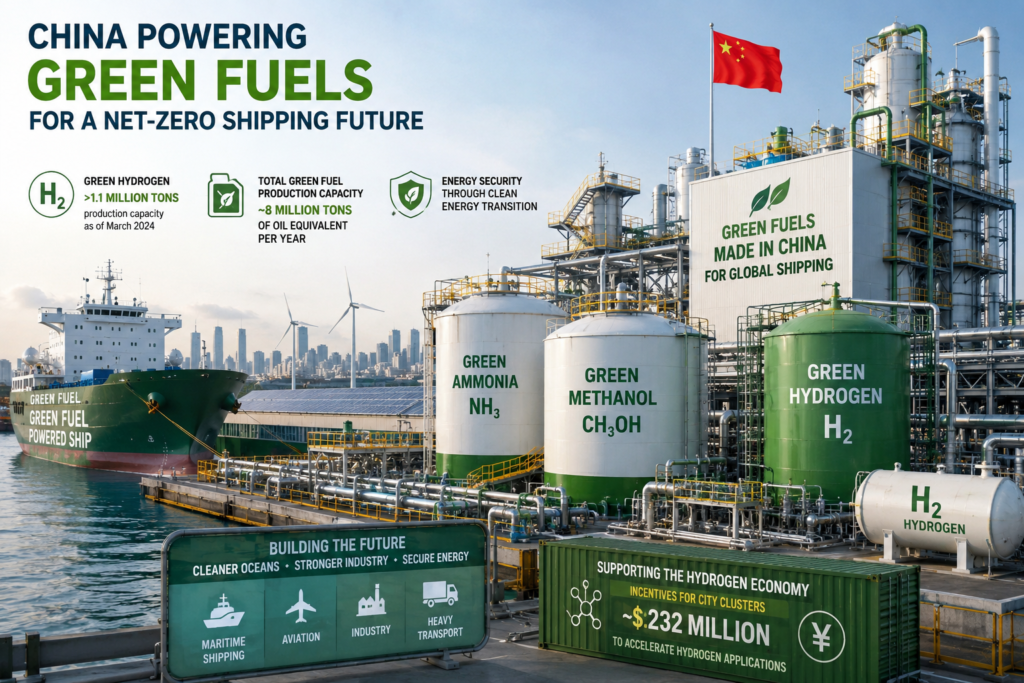
According to the NEA, China’s green hydrogen production capacity crossed 1.1 million tons as of March. Operational projects currently account for around 250,000 tons annually, more than twice the level recorded in 2024. An additional 900,000 tons of capacity is tied to projects already under construction, highlighting how aggressively the country is scaling its hydrogen sector following the launch of its national hydrogen strategy in 2022. Hydrogen remains a foundational component in the production of several marine fuels under development, particularly green methanol and green ammonia, both of which are attracting growing attention from shipowners and engine manufacturers.
Eight Million Tons of Green Fuel Capacity
China’s broader green fuel production capacity has now reached approximately 8 million tons of oil equivalent per year, according to the regulator. The sector is no longer limited to conventional biofuels such as ethanol and biodiesel. Investment is increasingly shifting toward next-generation fuels designed for hard-to-abate industries, including shipping and aviation. Current annual production capacity includes: Around 700,000 tons of green ammonia Approximately 380,000 tons of green methanol These fuels are expected to play a major role in future dual-fuel vessel operations, especially as international shipping faces tighter emissions regulations under the IMO’s decarbonization framework.
Energy Security Now Driving Fuel Strategy
One of the more significant developments is how Beijing is positioning green fuels not only as a climate solution, but also as an energy security strategy. Recent instability around the Strait of Hormuz has renewed concerns over dependence on imported oil and conventional fuel supply chains. Chinese authorities are now openly framing green fuels as part of a broader effort to reduce exposure to global petroleum disruptions. Industry analysts note that this marks a shift in narrative. Green fuel development is increasingly being tied to national resilience and industrial competitiveness, not just emissions reduction.
Support Expanding Beyond Shipping
China is also encouraging adoption through regional hydrogen incentive programs. The central government has committed roughly $232 million in support for selected city clusters focused on scaling hydrogen applications across sectors including shipping, aviation, manufacturing, and heavy transport. At the same time, China’s strong renewable energy build-out and electrolyzer manufacturing capacity continue to provide the backbone for scaling commercial green fuel production. While the industry is still in the early stages of achieving full commercial maturity, China’s pace suggests that future marine fuel supply chains could increasingly center around Asia.
Why This Matters
China’s scale could significantly influence future global pricing and availability of green marine fuels.
Shipowners planning methanol- or ammonia-ready vessels will closely watch fuel production growth in Asia.
Expanding hydrogen infrastructure may accelerate adoption of alternative fuels across ports and shipping corridors.
Energy security concerns are now becoming as important as emissions targets in shaping maritime fuel strategies.
China’s latest green fuel expansion signals that the transition to alternative marine fuels is moving from policy discussion to industrial execution. For shipping companies, fuel suppliers, and maritime investors, the developments could shape the next decade of bunker markets and vessel technology decisions.