Wind-Powered Ro-Ro Vessel Neoliner Origin Cuts Fuel Consumption by 70% in First Year
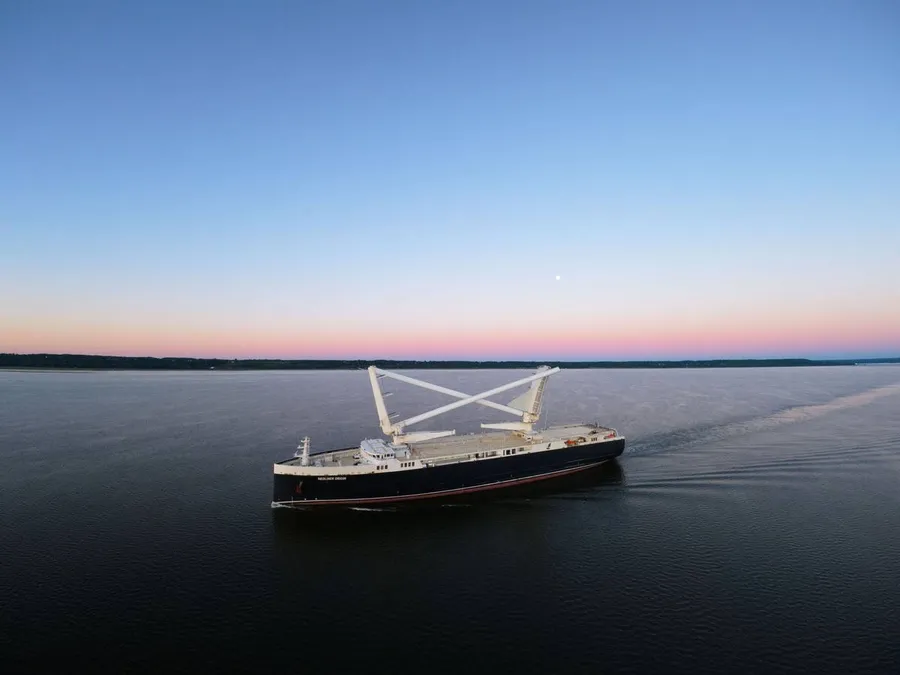
Wind-assisted propulsion is moving beyond experimental concepts and demonstrating its commercial potential in transatlantic shipping. French shipowner Neoline says its wind-powered Ro-Ro vessel Neoliner Origin reduced fuel consumption by 70% during 2026, marking a significant milestone for low-carbon cargo transportation.
Although technical challenges prevented the vessel from reaching its original 80% fuel-saving target, its first year of operations provides encouraging evidence that wind propulsion can deliver substantial efficiency improvements on commercial routes.
Main Article
French shipping company Neoline has reported significant fuel savings from its wind-powered Ro-Ro vessel Neoliner Origin following its first full year of commercial operations between Europe and North America.
The 136-metre vessel entered service in October 2025 and uses wind as its primary source of propulsion through two SolidSail rigs.
According to Neoline, the ship achieved a 70% reduction in fuel consumption during 2026, although its average reduction since entering service stands at approximately 66%.
Measured against the Global Logistics Emissions Council (GLEC) fleet reference, the vessel saved approximately 3,502 tonnes of fuel, avoiding an estimated 11,228 tonnes of CO₂ emissions.
A separate comparison against a simulated conventional vessel of similar size, operating on identical routes at 15 knots without sails, showed fuel savings ranging between 62% and 67%.
These results demonstrate the potential of wind propulsion to reduce dependence on conventional marine fuels without abandoning established commercial shipping operations.
Transatlantic operations and cargo performance
Built by RMK Marine, Neoliner Origin operates a transatlantic service connecting Montoir-de-Bretagne, near Saint-Nazaire in France, with Saint-Pierre-et-Miquelon, Baltimore and Halifax.
During its first year, the vessel recorded:
Operational indicator - First-year performance
Vessel length - 136 metres
Distance covered - More than 62,000 nautical miles
Commercial round trips - 9
Cargo units transported - 1,845
Cargo weight - Approximately 12,063 tonnes
Cargo volume - 55,889 m³
Passengers carried - More than 170
Its cargo portfolio includes vehicles, containers, oversized industrial equipment, machinery and refrigerated goods.
The ship can also accommodate up to 12 passengers in six double cabins, adding a passenger component to its commercial cargo operations.
SolidSail technology demonstrates its potential
The vessel's main propulsion system consists of two SolidSail rigs designed to capture wind energy and reduce the requirement for conventional engine power.
One of the most notable operational achievements came in June 2026, when Neoliner Origin reached 16.6 knots with its engine stopped, demonstrating its ability to maintain commercial sailing speeds using wind propulsion alone.
However, the first year was not without difficulties.
Technical faults affecting the sail system reduced the amount of time the vessel could operate with its full sail configuration. The challenges were particularly significant because the ship represents an early commercial application of this propulsion technology.
Neoline has acknowledged that these technical limitations prevented it from reaching its initial fuel-saving target of 80%.
Technical improvements planned for 2027
To improve performance, Neoline is working with Chantiers de l'Atlantique, the designer of the SolidSail system, to resolve the technical issues.
A scheduled maintenance period in February 2027 is expected to restore the rig to full operating capability.
The company has established a new target of achieving at least 78% fuel savings against the GLEC reference in 2027, with the possibility of approaching or exceeding 80%.
Neoline's chairman and CEO, Jean Zanuttini, described the first year as an important learning period, demonstrating that wind propulsion can significantly reduce fuel consumption and carbon emissions in commercial maritime transport.
Commercial interest in wind-powered shipping grows
Neoline was established in 2015 with the objective of developing a lower-carbon shipping model based primarily on wind propulsion.
Since Neoliner Origin entered commercial service, the company has strengthened its commercial relationships through partnerships with major logistics and shipping businesses, including CMA CGM and CEVA Logistics.
In September 2026, the vessel's service network was also expanded to include a call at Zeebrugge, Belgium.
These developments indicate that wind-assisted cargo transportation is attracting interest beyond technology developers, with established shipping and logistics companies exploring its commercial applications.
Why this matters
- For shipowners: A 70% reduction in fuel consumption demonstrates the potential for wind propulsion to lower operating expenses and reduce exposure to marine fuel price fluctuations.
- For seafarers: Wind-powered vessels introduce different operational requirements involving sail management, weather routing, propulsion monitoring and coordination between bridge and engine departments.
- For shipbuilders and marine engineers: The technical difficulties experienced by Neoliner Origin provide valuable real-world lessons for improving sail systems, structural arrangements and hybrid propulsion integration.
- For maritime decarbonisation: Commercial results from wind-powered vessels could encourage wider adoption of wind-assisted propulsion as shipping companies work towards reducing greenhouse gas emissions.
Conclusion
Neoliner Origin has demonstrated that wind propulsion can deliver substantial fuel savings in commercial transatlantic shipping, even while operating with technical limitations.
The next major milestone will be whether the planned 2027 improvements can push fuel reductions closer to 80% and establish wind-powered cargo transport as a commercially scalable solution.
Source: The Maritime Executive
Related Articles