PIL Orders Seven Methanol-Ready Feeders to Strengthen Asia-Pacific Network
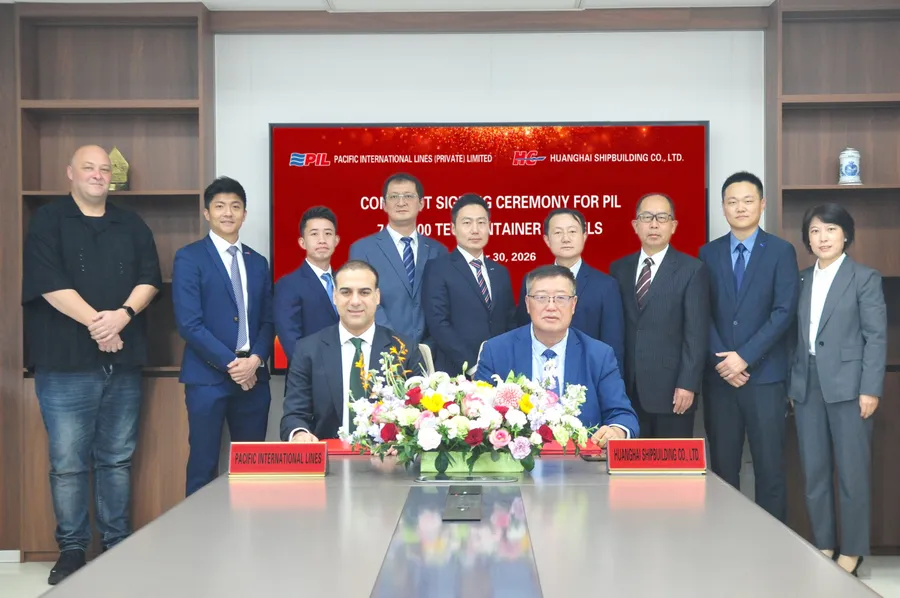
Pacific International Lines (PIL) is expanding its regional container fleet with seven new 1,400-TEU feeder vessels, combining capacity growth with a focus on fuel efficiency and future-ready ship design.
The China-built ships are expected to enter service between 2029 and 2030, reinforcing the carrier’s Intra-Asia and Pacific Islands operations while supporting its longer-term decarbonisation ambitions.
New Feeder Fleet Targets Regional Connectivity
Singapore-based Pacific International Lines has placed an order with Huanghai Shipbuilding in China for seven methanol-ready feeder containerships.
Each vessel will offer a capacity of 1,400 TEU, giving the order a combined carrying capacity of 9,800 TEU. The ships will be tailored to regional trading conditions, particularly routes connecting smaller ports with major transshipment hubs.
Measuring 172 metres in length and 25 metres in width, the vessels are designed to balance cargo capacity with the flexibility required for regional port operations.
For PIL, the investment represents an opportunity to strengthen connectivity across its regional network while improving the efficiency of its feeder services.
Energy Efficiency and Cargo Safety Take Centre Stage
The newbuildings will incorporate several technologies aimed at reducing fuel consumption and improving propulsion performance.
These include pre-swirl vanes and propeller boss cap fins, which help optimise water flow around the propeller. By improving propulsion efficiency, such arrangements can reduce the energy required to maintain vessel speed.
Cargo safety will also feature prominently in the design. The vessels are expected to include fixed fire water monitors and cargo hold water spray systems, providing additional protection against onboard cargo-related fire risks.
Digital technologies will support vessel monitoring and performance assessment, giving operators greater visibility into operational efficiency.
PIL CEO Lars Kastrup said the investment would enhance the company's capacity across its Intra-Asia and Pacific Islands network. He also emphasised the importance of operational efficiency in advancing PIL's long-term environmental objectives.
Methanol-Ready Design Supports Future Fuel Flexibility
One of the key features of the order is its methanol-ready designation.
The vessels are being designed to accommodate the potential future adoption of methanol as a lower-emission marine fuel. However, PIL has not confirmed whether the ships will be delivered with methanol dual-fuel engines installed.
This distinction is important for shipowners and operators. Methanol-ready designs can provide a pathway towards alternative fuels, but the eventual transition will depend on technical arrangements, investment decisions and the availability of suitable bunkering infrastructure.
The order forms part of PIL's broader fleet renewal and expansion programme, which supports its ambition to achieve net-zero emissions by 2050.
Huanghai Shipbuilding was selected for its technical expertise and shipbuilding capabilities. The financial value of the contract has not been disclosed.
Why this matters
- For shipowners: Energy-efficient feeder designs can help manage fuel expenditure and improve vessel competitiveness in regional trades.
- For seafarers: Newbuildings incorporating digital monitoring and enhanced safety systems will require crews to adapt to evolving onboard technologies and operational procedures.
- For regional operators: Additional feeder capacity can strengthen cargo connections between smaller ports and major transshipment centres.
- For the maritime industry: Methanol-ready vessels demonstrate how fleet renewal can preserve future fuel options without committing operators to immediate alternative-fuel adoption.
Conclusion
PIL's seven-vessel order highlights the growing importance of efficient, flexible feeder ships in Asia-Pacific container logistics.
With deliveries planned for 2029–2030, the investment combines immediate regional capacity expansion with a design approach intended to support the industry's longer-term transition towards cleaner shipping.
Source: Container News
Related Articles