Wind and Batteries Join Forces as Baltic Shipping Expands Hybrid Coaster Fleet
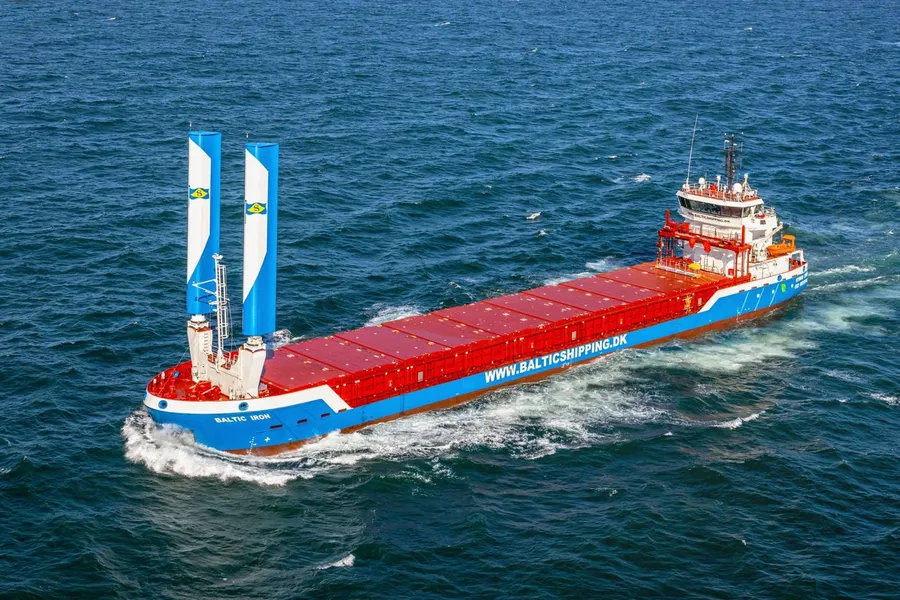
Baltic Shipping Company has added two Damen-built hybrid coasters equipped with wind-assisted propulsion and battery systems, giving its European shortsea fleet a practical combination of technologies aimed at cutting fuel use and emissions.
The 3,550-dwt sister vessels Baltic Timber and Baltic Iron are now in commercial operation, with wind providing additional thrust while onboard batteries support more efficient vessel operations.
Wind-Assisted Propulsion Meets Battery Power
Both vessels are fitted with two Econowind VentoFoils, which use aerodynamic forces to generate additional propulsion.
Rather than relying entirely on the main engine, the vessels can use available wind to provide supplementary thrust. This reduces the amount of engine power required under suitable operating conditions and is expected to lower fuel consumption by up to 12%.
That reduction can translate directly into lower CO₂ emissions, making wind assistance an attractive option for vessels operating on routes where favourable wind conditions are available.
The vessels also carry large battery systems, creating a hybrid arrangement in which different energy sources can work together to improve overall efficiency.
Baltic Timber Leads, Baltic Iron Follows
Baltic Timber entered service first, followed by its sister vessel Baltic Iron.
Both vessels are being commercially operated by Baltic Shipping Company on European shortsea routes, where predictable trading patterns and relatively frequent port calls provide opportunities to make use of energy-saving technologies.
For shortsea operators, even modest improvements in fuel efficiency can have a meaningful impact over hundreds of voyages. Fuel remains one of the largest operating costs for many cargo vessels, while emissions regulations are adding another incentive to reduce consumption.
A Practical Route to Lower Emissions
The significance of these vessels lies partly in their approach.
Rather than depending on a completely new propulsion fuel, the vessels combine technologies that can be deployed with conventional propulsion. Wind assistance reduces the work required from the main engine, while batteries provide additional flexibility in how onboard energy is used.
This makes the concept particularly relevant for shipowners looking for incremental efficiency gains while the availability, infrastructure and economics of alternative fuels continue to develop.
The actual performance benefit will naturally depend on factors such as wind conditions, route, vessel loading, speed and operating profile.
Customer Pressure Is Also Driving Change
Baltic Shipping's investment reflects a wider shift in the European shipping market.
Cargo owners and logistics customers are increasingly looking for ways to reduce the emissions associated with transportation. For ship operators, that is creating demand for technologies that can demonstrate measurable reductions without compromising cargo capacity or commercial flexibility.
The company manages and charters around 95 dry cargo vessels and operates across areas including vessel management, chartering, project cargo and port services.
The addition of the two hybrid coasters therefore provides a real-world demonstration of how wind-assisted propulsion and battery technology can be incorporated into an existing commercial fleet.
Why this matters
- For shipowners: Wind assistance and batteries offer a way to reduce fuel consumption without completely replacing conventional propulsion systems.
- For operators: Route planning, weather data and voyage optimization could become increasingly important in maximixing the benefit from wind-assisted vessels.
- For charterers and cargo owners: Lower fuel consumption can help reduce the carbon footprint associated with shortsea transportation.
- For the wider industry: The vessels demonstrate that decarbonization can involve combining several technologies rather than relying on a single alternative fuel.
Conclusion
Baltic Timber and Baltic Iron show how relatively established technologies can be combined to improve the efficiency of working cargo vessels. Wind, batteries and conventional propulsion are being brought together in a commercially practical package.
Source: Marine Link
Related Articles