Passive Cooling Trial Cuts Container Temperatures by Nearly 20°C at Valenciaport
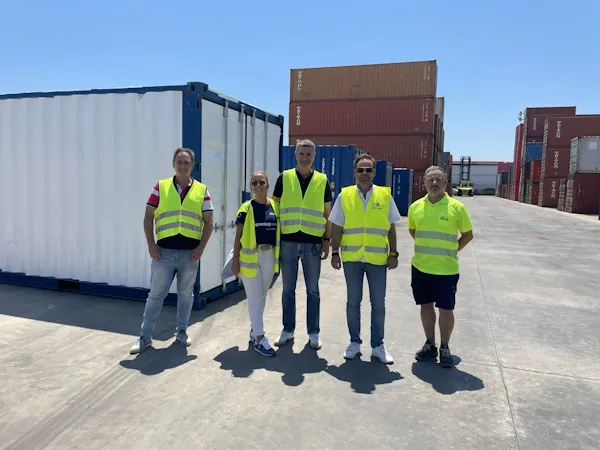
A new trial at Spain’s Valenciaport Sandbox has demonstrated how a passive cooling material could significantly reduce heat inside shipping containers without electricity. The technology was tested during peak Mediterranean summer conditions, offering a potential tool for cargo protection, worker safety and port infrastructure resilience.
Testing Cooling Technology Under Real Port Conditions
The pilot involved Cooling Photonics, a startup developing passive radiative cooling materials, and Transbase Soler, a depot within the Valencia port community.
Supported by the Valenciaport Foundation and Opentop, Valenciaport’s open innovation hub, the project moved beyond laboratory testing and into an operational depot environment.
The trial ran for more than 15 consecutive days during summer. Four identical 20-foot containers were positioned under comparable solar exposure and monitored using independent temperature sensors.
Each container represented a different configuration:
- One remained untreated as the reference unit.
- One used a conventional thermal blanket inside.
- One had the new cooling material installed on its roof.
- One was coated on both the roof and side walls.
Temperature readings were taken every 15 minutes, producing more than 5,600 measurements during the trial.
Nearly 20°C Difference at Peak Conditions
The temperature data showed a substantial difference between the untreated and fully coated containers.
The conventional container reached an internal temperature of 53°C and remained above 40°C for more than one-third of the monitoring period.
By comparison, the container protected with the cooling material on both its roof and side walls recorded a maximum internal temperature of just 34.2°C.
Across the trial, the daily peak temperature was reduced by an average of 17.5°C, with the difference reaching as much as 22°C on the hottest day.
The principle behind the technology is different from conventional insulation. Instead of primarily slowing heat transfer and potentially retaining heat inside the structure, the material reflects solar radiation before it is absorbed by the container’s steel surfaces. The container can then release accumulated heat naturally as conditions cool overnight.
Why This Matters Beyond Containers
For shipping and logistics operators, controlling temperature inside conventional containers can be challenging, particularly when units are temporarily stored in open depots or terminals under intense sunlight.
A passive system that requires no electrical power could offer another way to manage heat exposure.
Potential applications extend beyond cargo containers. Lower temperatures could help protect temperature-sensitive cargo, reduce thermal stress on materials and improve conditions inside containers being used as temporary workshops, storage areas or offices.
The same principle could potentially be applied to other port equipment, including electrical cabinets and power electronics, where excessive heat can contribute to equipment failures or operational interruptions.
The technology could also become relevant to climate adaptation. As ports and logistics facilities deal with increasingly severe summer heat, passive measures that reduce thermal loads without adding electricity demand could become part of broader resilience strategies.
Juan Manuel Díez, Head of Innovation at the Port Authority of Valencia, described the project as an example of the Valenciaport Sandbox approach: allowing new technologies to be tested under actual port conditions and evaluated using operational data.
For the port community, the significance is therefore not limited to the cooling material itself. The pilot demonstrates how startups can move from laboratory concepts to measurable trials within working maritime infrastructure.
From Startup Technology to Port-Ready Solution
The involvement of Opentop is also significant. Its role was to connect Cooling Photonics with the port community and provide access to an environment where the technology could be tested under realistic operating conditions.
For startups developing maritime technologies, this type of access can be critical. A promising laboratory result does not necessarily translate directly into reliable performance on a working terminal, depot or vessel.
Real-world pilots provide operators with data while giving technology developers an opportunity to identify practical improvements before commercial deployment.
The Valenciaport trial therefore provides a useful model for how ports can support innovation without committing immediately to large-scale deployment.
Why this matters
- For terminal and depot operators: Passive cooling could reduce container heat without adding electricity consumption or active cooling equipment.
- For cargo owners and logistics companies: Lower internal temperatures could provide additional protection for heat-sensitive cargo and materials during storage.
- For seafarers and port workers: Cooler container interiors could improve conditions where containers are temporarily used for work, storage or operational purposes.
- For port planners and equipment operators: Passive thermal management could contribute to climate resilience and potentially improve the reliability of heat-sensitive electrical equipment.
The Bigger Maritime Picture
The Valenciaport pilot highlights a broader direction in maritime innovation: relatively simple material technologies can potentially address operational problems without adding significant energy demand.
The next challenge will be determining how the material performs over longer periods, across different climates and under the wear and maintenance conditions encountered in commercial logistics operations.
The Ecosailor takeaway: real-world testing is turning passive cooling from a laboratory concept into a measurable port technology, with potential applications across containers, terminals and wider maritime infrastructure.
Source: The Maritime Executive
Related Articles