ABS Validates Breakerless MVDC Power System, Paving the Way for High-Power Electric Ships
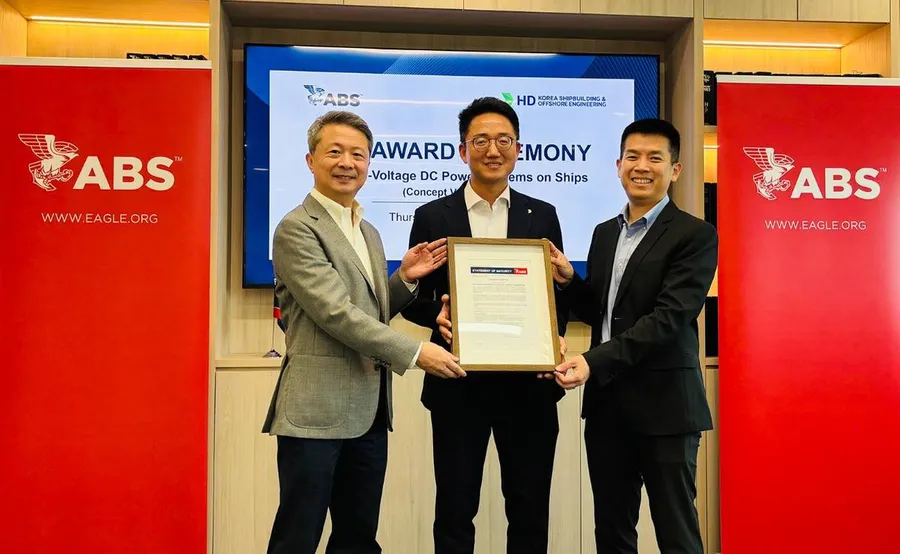
The maritime industry is taking another step towards advanced electrical propulsion and more efficient onboard power distribution. HD Korea Shipbuilding & Offshore Engineering (HD KSOE) and HD Hyundai Heavy Industries (HHI) have secured concept verification from the American Bureau of Shipping (ABS) for a breakerless medium-voltage direct current (MVDC) power system designed for large commercial vessels.
The technology targets ships requiring approximately 30 MW of electrical power, addressing the growing demand for higher-capacity and more efficient marine electrical systems.
A New Approach to Shipboard Power Distribution
As commercial vessels become larger and incorporate more electrical equipment, conventional power distribution arrangements face increasing demands in terms of capacity, efficiency and system complexity.
The proposed breakerless MVDC architecture is designed to address these challenges through an integrated electrical distribution system supported by advanced control and fault-management capabilities.
Unlike conventional arrangements that rely on traditional circuit breakers for electrical fault isolation, the breakerless concept uses an advanced control and protection architecture to manage faults and maintain system resilience.
The objective is to improve energy efficiency while supporting the increasing electrification requirements of modern commercial ships.
The technology is particularly relevant to vessels with substantial electrical loads, where efficient power management is becoming increasingly important for propulsion, auxiliary machinery and other onboard systems.
Development Moves Towards Prototype Validation
The latest ABS verification follows the successful completion of the technology's Feasibility Stage in 2025.
The joint development project began in 2024, bringing together HD KSOE, HHI and ABS to investigate the potential application of MVDC technology in maritime environments.
With concept verification now secured, the project is preparing to enter its next development phase: Prototype Validation.
This stage will be important in determining how the proposed architecture performs under practical operating conditions and whether its control and protection systems can satisfy the demanding reliability requirements of commercial shipping.
ABS is also working with shipbuilders and technology developers to establish technical guidance that can support the wider adoption of high-capacity electrical systems across the maritime industry.
Why This Matters
- For shipowners: More efficient electrical distribution could help reduce onboard energy losses and support future vessel designs with higher electrical power requirements.
- For marine engineers: MVDC technology introduces new requirements for electrical protection, fault management, system monitoring and maintenance. Engine and electrical departments may need additional technical expertise as these systems develop.
- For shipbuilders: High-capacity MVDC architecture could provide greater flexibility when designing electrically intensive vessels and integrating advanced propulsion technologies.
- For the maritime industry: The development supports the broader transition towards ship electrification, potentially creating opportunities for more efficient propulsion and onboard energy management.
Conclusion
ABS concept verification marks an important development milestone for breakerless MVDC technology, moving the concept closer to practical maritime application.
The next challenge will be demonstrating prototype performance, particularly electrical safety, fault management and operational reliability under real-world shipboard conditions.
Source: Marine Link
Related Articles