MOL Names First LNG Carrier Equipped With Twin Rigid Wind Sails

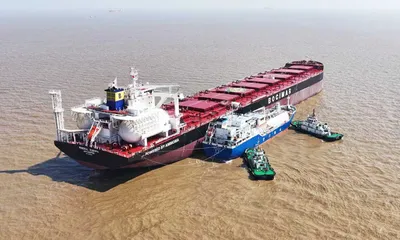
Mitsui O.S.K. Lines (MOL) has named Fujin Sailor, the world’s first LNG carrier equipped with rigid wind sails—and the first to carry two of them. The vessel is set to enter long-term charter service with Chevron after delivery later this month.
Built by Hanwha Ocean at its Geoje shipyard in South Korea, the 295-metre LNG carrier represents a significant step in bringing wind-assisted propulsion into a vessel type where cargo containment, ship-to-shore compatibility and operational safety leave little room for major design changes.
The Fujin Sailor can transport approximately 174,000 cubic metres of LNG. Its two telescoping Wind Challenger sails are positioned towards the forward section of the vessel. Each sail is approximately 49 metres high and 15 metres wide when fully deployed, with a three-panel construction made from fibre-reinforced plastic.
For an LNG carrier, adding large wind sails involves more than simply finding a suitable location on deck. MOL, Chevron and Hanwha Ocean worked together to develop a configuration that would have minimal impact on the vessel's existing characteristics.
The sail arrangement was designed to preserve the ship's existing mooring configuration and limit changes to ship-to-shore compatibility. The installation was also designed to keep additional windage within manageable limits.
Safety and cargo integrity were key considerations. MOL and its partners carried out a comprehensive risk assessment covering issues such as sail positioning, visibility, emergency procedures and other operational safeguards. The concept subsequently received approval in 2024.
The impact of the sail installation on the LNG cargo containment system was also assessed in cooperation with GTT, the company behind the patented membrane-type LNG tank technology used in the vessel.
The ship combines the wind sails with several other efficiency technologies. Its propulsion system uses an Everllence (formerly MAN Energy Solutions) main engine, while air lubrication and shaft generators are also installed to help improve overall energy performance.
Fujin Sailor is the fourth MOL vessel to receive the company's Wind Challenger rigid sail technology, following two coal carriers and a bulk carrier.
MOL is already preparing for the next LNG application. A second LNG carrier of a similar size, also equipped with two rigid sails, is scheduled for delivery later this year. That vessel will enter charter service with Tokyo LNG Tanker, a subsidiary of Tokyo Gas, and is also being constructed by Hanwha Ocean.
The broader programme is expanding quickly. MOL has committed to installing Wind Challenger sails on 11 vessels, including six additional bulk carriers being built by Oshima Shipbuilding in Japan, each equipped with a single rigid sail.
The development comes as wind-assisted propulsion moves beyond pilot projects and into a wider range of commercial vessel types. Other technologies are also being tested: Maersk and Anemoi Marine Technologies, for example, are planning the first trial of a wind rotor on a containership, scheduled for mid-2027.
Why this matters
- Wind is becoming a practical auxiliary power source: Rigid sails can provide additional propulsion when wind conditions are favourable, potentially reducing fuel consumption and emissions.
- LNG carriers present a tougher engineering challenge: Cargo containment, visibility, mooring arrangements and ship-to-shore interfaces all have to be considered before adopting large deck-mounted systems.
- Efficiency is increasingly about combining technologies: Wind propulsion, air lubrication and shaft generators demonstrate how multiple efficiency measures can work together rather than relying on a single solution.
- The technology is moving toward fleet-scale adoption: MOL's commitment to 11 Wind Challenger-equipped vessels suggests wind assistance is evolving from a demonstration project into a broader fleet strategy.
The Fujin Sailor is more than a new LNG carrier with sails—it is a test of how wind-assisted propulsion can be integrated into highly specialised commercial vessels without fundamentally changing their operating profile.
As fuel costs, emissions requirements and decarbonisation targets continue to influence fleet decisions, wind could become another tool in the shipowner's efficiency toolbox.
Source: The Maritime Executive
Related Articles