Germany’s LNG Network Expands as Fourth FSRU Arrives at Stade
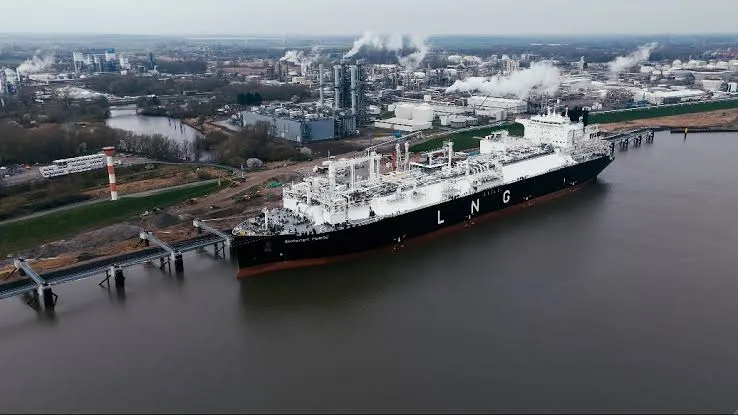
Germany is preparing to bring another floating LNG import terminal into operation, with the Energos Force returning to the country as work advances on the Stade LNG facility near Hamburg.
The terminal is part of Germany’s rapid expansion of LNG infrastructure, launched after the disruption of Russian pipeline gas supplies in 2022. With the EU also moving toward a broader phase-out of Russian gas imports, the new facility adds another piece to Germany’s alternative gas supply network.
Energos Force returns to the Elbe
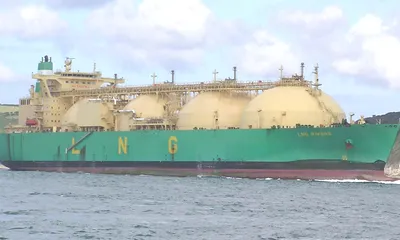
The 94,361-dwt Energos Force has arrived at the LNG terminal site at Stade-Bützfleth, on the Elbe River.
The FSRU is expected to complete commissioning and begin operations by November. By 2027, the terminal is planned to have the capacity to feed up to 3.2 billion cubic metres of natural gas per year into Germany’s gas grid.
Deutsche Energy Terminal GmbH (DET), the state-owned company managing the project, says the facility will become an important part of Germany’s energy supply infrastructure.
Before returning to Germany, Energos Force had been sub-chartered by DET and deployed in Jordan while construction and preparation work continued at Stade.
The vessel will now operate under a long-term charter to DET.
How the FSRU fits into the system
Built in 2021, Energos Force can regasify up to 500 million standard cubic feet per day (MMSCFD) using a closed-loop system with steam boilers.
During suitable summer conditions, its capacity can increase to as much as 750 MMSCFD by using Elbe River water in an open-loop configuration.
The FSRU essentially serves as a floating processing facility. LNG arriving at the terminal is stored onboard, converted back into natural gas and then transferred into the onshore gas network.
For 2027, DET estimates that Stade could supply enough gas to provide the equivalent of annual heating demand for around 2.6 million four-person households.
Germany’s FSRU fleet is growing
Stade will become the fourth FSRU managed by DET, following the rapid development of Germany’s floating LNG infrastructure.
The programme began in December 2022 with Höegh Esperanza at Wilhelmshaven. The vessel became Germany’s first LNG terminal to enter operation and can store approximately 170,000 cubic metres of LNG, with regasification capacity of up to 750 MMSCFD.
Wilhelmshaven added a second FSRU, Excelsior, in 2025. The vessel has 138,000 cubic metres of storage capacity and can regasify up to 500 MMSCFD. Its terminal is located at an offshore island jetty approximately 1.5 km from shore.
At Brunsbüttel, the Höegh Gannet is operating from an existing port berth while preparations continue for its eventual move to a purpose-built jetty. The vessel has 170,000 cubic metres of storage capacity and regasification capability of up to 750 MMSCFD.
The Stade facility will therefore add another significant LNG receiving point to Germany’s northern coastline.
A major infrastructure build in a short timeframe
Germany's FSRU programme has been notable for the speed at which floating LNG infrastructure was deployed following the energy disruption caused by Russia's invasion of Ukraine.
The projects have required more than simply chartering vessels. New jetties, onshore infrastructure, safety systems and extensive technical assessments have had to be developed alongside the FSRUs.
For the maritime industry, the programme illustrates how FSRUs can provide a relatively flexible route for countries seeking to establish LNG import capacity, particularly when compared with the longer development timelines associated with conventional land-based terminals.
It also demonstrates the importance of specialised vessels in national energy infrastructure. The FSRU is effectively both a ship and a critical component of the country's gas supply chain.
Why this matters
- For shipowners: Long-term FSRU charters continue to create demand for specialised LNG infrastructure vessels.
- For ports: LNG terminals require purpose-built berths, safety systems, marine infrastructure and careful coordination with surrounding port traffic.
- For gas and energy operators: FSRUs can provide additional import and regasification capacity without relying entirely on conventional onshore terminals.
- For maritime professionals: The expansion highlights the growing role of LNG carriers and FSRUs in Europe's evolving energy logistics network.
Germany's LNG strategy has moved quickly from emergency response to a more established import network.
With the Energos Force now back at Stade, the next milestone is getting the terminal fully commissioned and turning another FSRU into an operational link between global LNG shipping and Germany's gas grid.
Source: The Maritime Executive
Related Articles