China Completes World-First Commercial Green Ammonia Bunkering at Sea
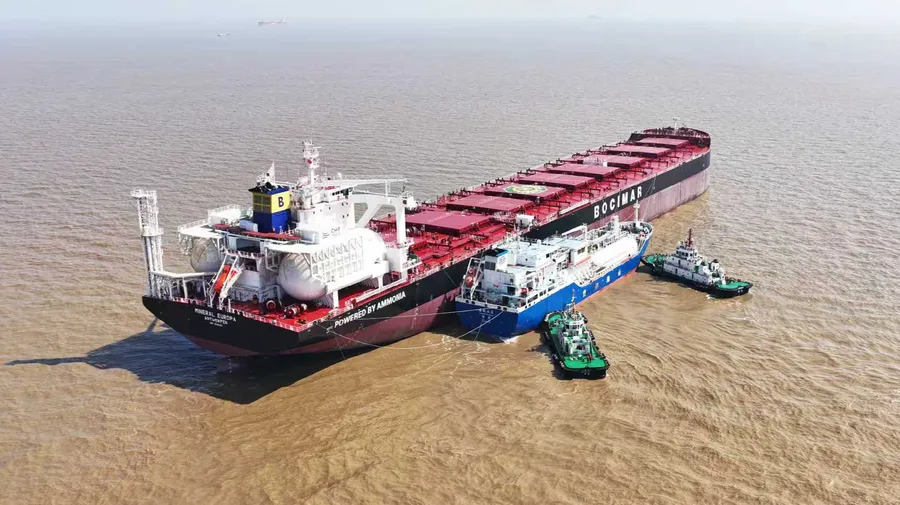
China has completed what is reported to be the world’s first commercial ship-to-ship bunkering operation using green ammonia, transferring 1,000 tonnes of the alternative fuel to a newly delivered ammonia-powered bulk carrier.
The milestone moves ammonia-fuelled shipping closer to commercial reality, while highlighting the safety procedures and supply-chain infrastructure required to support next-generation marine fuels.
Green Ammonia Delivered Directly to an Oceangoing Vessel
The operation took place on 13 and 14 October at an anchorage off Zhoushan, China. The bunkering vessel Shenghang Yongle supplied 1,000 tonnes of green ammonia to Mineral Europa, a 210,000 dwt bulk carrier owned by Belgian shipowner CMB.TECH.
Delivered earlier in October, Mineral Europa is described as the world’s first ammonia-powered dry bulk carrier. Following bunkering, the vessel is heading across the Pacific to Australia for commercial operations.
The use of a dedicated bunkering vessel demonstrates how ship-to-ship transfers could supply large oceangoing vessels without relying exclusively on shore-based bunkering facilities.
According to Li Jingguang, chairman of China Energy Engineering’s hydrogen division, the offshore transfer model offers significant advantages. He indicated that future operations could increase transfer volumes to 2,000 or even 3,000 tonnes.
Building a Supply Chain from Renewable Power to Ship
The operation involved China Energy Engineering, CMB.TECH and Jiangsu Andefu Energy Technology, connecting renewable fuel production with delivery to a commercial vessel.
The ammonia was produced using renewable electricity at China Energy Engineering’s Songyuan green hydrogen and ammonia project in Jilin province. It was then transported through Nanjing to Zhoushan for the bunkering operation.
This end-to-end chain is important because alternative-fuel shipping requires more than vessels capable of using new fuels. Producers, storage facilities, transport operators, ports and bunkering providers must also be able to deliver fuel reliably and at commercially viable costs.
Green ammonia can offer substantial lifecycle greenhouse-gas reductions when produced using renewable energy. However, its overall environmental benefit depends on the production process, transport emissions and how the fuel is used onboard.
Safety Remains Central to Ammonia Adoption
Ammonia presents a distinct set of risks compared with conventional marine fuels. It is highly toxic, and accidental releases can threaten crew members, port workers and nearby communities.
Chinese maritime authorities supervised the transfer and implemented special safety measures for handling the fuel. As ammonia bunkering expands, effective procedures for transfer operations, leak detection, emergency response, crew training and protective equipment will be essential.
For shipowners and operators, the commercial opportunity will therefore need to be balanced against investment in safety systems, specialised training and suitable port infrastructure.
Why This Matters
- For shipowners: Commercial-scale bunkering demonstrates a potential pathway for operating ammonia-fuelled vessels, although fuel availability, cost and infrastructure remain critical considerations.
- For seafarers: Ammonia introduces serious toxic-exposure risks, making specialist training, emergency preparedness and strict bunkering procedures essential.
- For ports and bunker suppliers: Ship-to-ship transfers could create a scalable supply model, provided suitable vessels, storage systems and safety arrangements are available.
- For the maritime energy transition: The operation links renewable fuel production directly to a commercial ship, providing a practical test of the supply chains needed to reduce shipping emissions.
The Bottom Line
China’s green ammonia bunkering milestone demonstrates progress in bringing alternative marine fuels into commercial shipping. The next challenge is to establish safe, dependable and cost-competitive supply networks that can support wider adoption across the global fleet.
Source: splash247
Related Articles