Steerprop Wins Propulsion Order for US Coast Guard Arctic Security Cutters
Finland’s Steerprop has secured a contract to supply complete propulsion systems for four Arctic Security Cutters (ASCs) being constructed by Bollinger Shipyards for the U.S. Coast Guard.
The vessels will combine ice-capable propulsion with high maneuverability, supporting Coast Guard missions along U.S. coastlines, with a particular focus on Arctic operations.
Dual Propellers Designed for Ice Operations
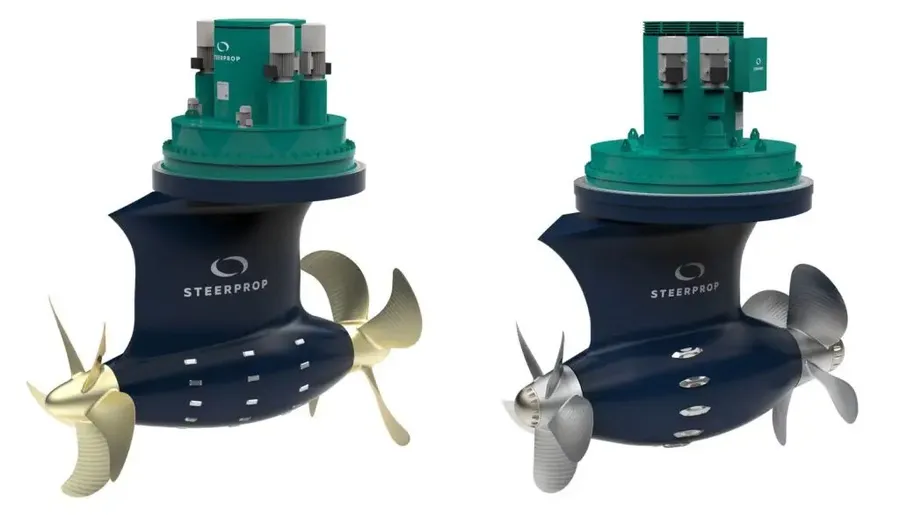
Each Arctic Security Cutter will be fitted with two Steerprop Contra-Rotating Propeller (CRP) azimuth units and two tunnel thrusters.
The main propulsion system will use Steerprop’s SP 120 CRP ARC LM azimuth propulsors, while SP 25 TT ARC tunnel thrusters will provide additional maneuvering capability.
The cutters are based on an existing Multi-Purpose Icebreaker (MPI) design. During the procurement process, Steerprop demonstrated that its contra-rotating configuration could generate greater thrust and improve efficiency compared with conventional single-propeller arrangements in an MPI reference scenario.
That combination is particularly relevant for vessels expected to work in ice, where propulsion systems must deliver both power and precise control while operating in demanding conditions.
Efficiency Gains Under Testing
Steerprop's CRP technology places two propellers on the same shaft line, rotating in opposite directions. The arrangement is designed to recover rotational energy that would otherwise be lost behind a conventional propeller while producing additional thrust.
Model testing carried out in 2024 showed the system producing approximately 10% more thrust at the same power than a comparable single-propeller system.
Alternatively, the same thrust could be achieved with 13.9% less power.
Net thrust performance was also measured at 10–17% higher than comparable single-pull propeller solutions.
For an ice-going vessel, these differences can have practical implications. More available thrust can improve icebreaking capability and maneuvering, while lower power requirements can potentially translate into reduced fuel consumption during operations.
Arctic Experience a Key Factor
Steerprop’s existing experience with ice-capable vessels was an important part of the selection process.
The Finnish manufacturer says its propulsion systems are installed on around one-third of the world's operational azimuth-propelled icebreakers. The company also incorporates several design features specifically aimed at ice operations.
One example is its tunnel-thruster configuration, which does not require traditional protective ice grids. This can help avoid additional resistance and reduce potential complications associated with ice accumulation around thruster openings.
The cutters will be capable of operating along all U.S. coastlines, while their Arctic mission profile places particular emphasis on propulsion reliability and maneuverability in cold and ice-affected waters.
Steerprop is scheduled to deliver the four propulsion packages between 2027 and 2029.
Why this matters
- Ice-capable propulsion is becoming more specialized: Arctic vessels need propulsion systems designed around thrust, maneuverability and survivability in ice—not simply conventional marine propulsion adapted for cold conditions.
- Efficiency matters operationally: The reported reduction in power requirements could help reduce energy consumption when equivalent thrust is required.
- Azimuth propulsion offers maneuverability: Independent directional propulsion can provide Coast Guard vessels with greater control when operating near ice, ports and other constrained environments.
- Arctic operations are gaining strategic importance: Reliable vessels and propulsion systems will become increasingly important as maritime activity and government operations expand in northern waters.
The Arctic Security Cutter program highlights the growing importance of propulsion technology that can combine ice performance, maneuverability and energy efficiency.
For ship designers and operators, the challenge is no longer simply breaking through ice—it is doing so with greater control and less energy.
Source: Marine Link
Related Articles