AIQ and Quartermaster Partner to Develop AI-Powered Security Systems for Offshore Operations
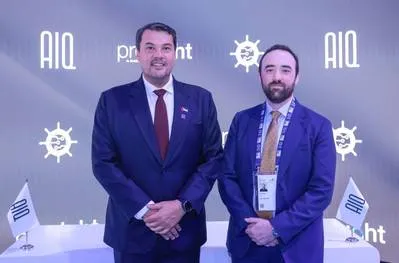
Artificial intelligence is becoming an increasingly important part of offshore maritime security, with companies looking beyond traditional vessel-tracking systems to improve the protection of critical energy infrastructure.
Abu Dhabi-based AIQ and US maritime intelligence company Quartermaster have joined forces to explore AI-driven monitoring and security solutions for offshore oil and gas operations, beginning in the UAE and potentially expanding across international markets.
Main Article
The partnership was announced through a strategic collaboration agreement signed during ADIPEC 2026 in Abu Dhabi.
The initiative brings together AIQ's experience in industrial artificial intelligence and offshore energy operations with Quartermaster's maritime surveillance technology.
The immediate objective is to develop integrated solutions capable of improving maritime awareness and protecting offshore installations, including oil platforms, pipelines and subsea infrastructure.
The initial focus will be the United Arab Emirates, with opportunities expected to be explored across the wider Gulf Cooperation Council (GCC) region and other international markets.
Combining maritime intelligence with artificial intelligence
A key component of the partnership is Quartermaster's SmartMast maritime sensor network.
Unlike conventional vessel-monitoring approaches that depend heavily on Automatic Identification System (AIS) information, SmartMast is designed to detect and identify vessels independently of AIS data, GNSS and satellite systems.
This capability is particularly relevant in offshore environments where vessels may operate without transmitting AIS information or where conventional tracking coverage is limited.
According to Quartermaster, SmartMast has already recorded more than three million detections across 25 countries, demonstrating its international operational reach.
AIQ brings additional capabilities through its SMARTi AI-enabled computer vision technology, which has already been deployed on dozens of vessels operating in the UAE.
The technology uses artificial intelligence to analyse visual information and support maritime safety and operational monitoring.
By combining these systems, the companies aim to develop a more comprehensive picture of offshore maritime activity.
Protecting offshore energy infrastructure
The collaboration will evaluate commercial opportunities and demonstrate integrated solutions for monitoring critical offshore assets.
The proposed applications include:
- Unauthorised vessel detection: Identifying vessels approaching restricted offshore areas without appropriate authorisation.
- Suspicious activity monitoring: Improving awareness of unusual maritime movements around energy installations.
- Offshore infrastructure protection: Monitoring oil platforms, pipelines and subsea assets against potential security threats.
- Safety incident detection: Supporting the identification of operational hazards and potentially dangerous situations.
- Risk assessment: Using collected maritime data to help offshore operators make more informed security and operational decisions.
Another interesting aspect is the potential insurance benefit.
The companies believe that improved monitoring, incident detection and documented risk-management procedures could help offshore operators demonstrate stronger security controls and potentially secure more favourable insurance outcomes.
Why this partnership matters for the Gulf
The Gulf region is home to some of the world's most important offshore oil and gas operations.
Its energy infrastructure includes offshore production platforms, subsea pipelines, export terminals and supporting vessel networks.
These installations require continuous monitoring because security incidents, unauthorised vessel movements or operational accidents can disrupt production and create significant financial consequences.
Traditional AIS-based monitoring remains useful, but it cannot provide complete visibility of every vessel operating in an area.
Combining independent maritime sensors with AI-powered computer vision could help close some of these monitoring gaps.
The partnership also reflects a wider shift towards predictive and data-driven maritime security rather than relying exclusively on conventional surveillance and incident response.
Why this matters
- For offshore operators: Integrated AI surveillance could improve protection of offshore platforms, pipelines and subsea infrastructure while strengthening operational risk management.
- For seafarers: AI-assisted monitoring may help bridge teams identify nearby vessels, unusual movements and potential safety threats earlier.
- For maritime security: Independent vessel detection offers an additional layer of awareness when AIS information is unavailable, incomplete or unreliable.
- For maritime technology companies: The partnership demonstrates growing commercial opportunities in combining artificial intelligence, computer vision and maritime sensor networks.
Conclusion
The AIQ–Quartermaster partnership highlights how artificial intelligence is moving beyond vessel efficiency and into the protection of critical maritime infrastructure.
If successfully developed and deployed, these integrated technologies could become an important part of the next generation of offshore security and maritime risk management.
Source: Marine Link
Related Articles