Six Tankers Reported Hit in a Week as Strait of Hormuz Security Deteriorates
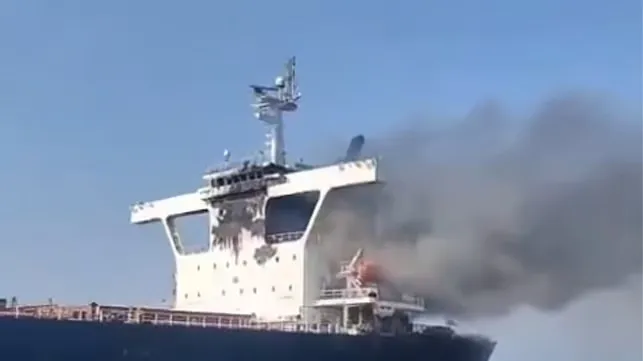
A new series of tanker incidents is putting commercial shipping under renewed pressure in the Strait of Hormuz, with six tanker strikes reported within a week. For shipowners, masters and crews, the latest attacks underline how quickly a critical trading route can shift from a difficult operating environment to a high-risk transit zone.
Two More Tanker Incidents Add to Growing Security Risk
The latest incidents involved a Kuwait Oil Tanker Company (KOTC) VLCC, Kazimah III, and another tanker reported to be Panama-flagged.
UK Maritime Trade Operations (UKMTO) said a tanker was struck by an unknown projectile while transiting the Strait on October 1, with a fire reported onboard. The crew was reported safe. Maritime-security sources subsequently identified the vessel as Kazimah III, a roughly 317,250-DWT crude tanker.
A further incident was reported on October 2 involving a Panama-flagged tanker. Security consultancy Ambrey said the vessel was struck while transiting near Oman, with smoke visible from the vessel's stern. No injuries or pollution were reported in the initial assessment.
The incidents follow three tanker attacks reported around September 30, adding to a rapidly developing sequence of attacks against commercial vessels using the waterway.
The Pattern Is Becoming More Difficult to Ignore
Several vessels reported hit during the latest incidents have links to operators or owners in the Gulf region.
Maritime-security reporting has identified Mersin Prosperity, Sinbad and Al Ruwais among vessels struck in recent days. Some reports have linked these vessels to a list maintained by Iranian authorities of ships considered non-compliant with Iranian restrictions.
However, the reported attacks have not been limited to vessels appearing on that list. Two Kuwait-controlled tankers were also reportedly targeted this week, complicating assumptions about which commercial ships may be exposed.
The geographic pattern is also notable. Several of the incidents occurred in the southern part of the Strait, close to Omani waters, meaning that simply remaining outside Iranian territorial waters does not eliminate the operational risk.
UKMTO continues to advise vessels operating through the area to maintain caution and report suspicious activity.
Shipping Is Still Moving — But Under a Different Risk Calculation
The latest attacks do not mean that all commercial traffic has stopped.
Lloyd's List Intelligence reported that non-Iranian-linked vessels completed at least 379 voyages through Hormuz during September, making it one of the busiest months since the conflict began outside the earlier memorandum-of-understanding period.
That creates a difficult operating equation for owners and charterers.
The Strait remains commercially important, but each transit now involves additional considerations around security information, routing, insurance, crew exposure, communications and potential military activity.
For masters and shipboard teams, the practical consequence is that voyage planning cannot rely solely on the normal navigational picture. Security advisories, company procedures and real-time reporting become increasingly important alongside conventional passage planning.
Pressure on Iran's Oil Exports
The shipping disruption is occurring alongside a major reduction in Iran's seaborne crude exports.
Preliminary tanker-tracking data reported by several market analysts indicate that Iran recorded no crude loadings onto tankers during September, compared with approximately 250,000 barrels per day in August.
That suggests the maritime restrictions are having a substantial effect on Iran's ability to move crude by sea.
At the same time, the wider Gulf oil trade has not disappeared. Alternative routes, naval protection and continued commercial transits have allowed portions of regional energy flows to continue despite the security situation.
The distinction matters: disruption to Iranian exports does not automatically mean that all Gulf energy shipments have stopped.
125 Commercial Vessels Redirected
The United States has also expanded enforcement activity around the maritime blockade.
US Central Command said that, as of September 30, its forces had redirected 125 commercial vessels to enforce compliance with the blockade.
For commercial operators, such actions add another layer of uncertainty. A vessel can face risks not only from attacks or projectiles but also from military interception, changes to routing requirements and rapidly changing instructions from authorities.
Meanwhile, diplomatic efforts between Washington and Tehran remain unresolved, leaving the shipping industry with limited visibility over how long the current operating conditions will continue.
Why this matters
- For shipowners and charterers: Security risk is increasingly becoming a direct factor in voyage planning, insurance exposure, freight economics and vessel deployment.
- For masters and crews: Recent incidents demonstrate that commercial tankers can encounter threats even while operating close to Omani waters, making current security guidance and company procedures critical.
- For energy markets: Restrictions on Iranian crude exports are tightening an already disrupted regional energy supply chain, while other Gulf producers continue seeking alternative ways to maintain exports.
- For maritime operators: The combination of vessel attacks, military enforcement and uncertain diplomacy makes the Strait a dynamic risk environment requiring continuous reassessment rather than a one-time voyage decision.
The Hormuz Risk Remains Fluid
The latest tanker incidents show that the security situation around the Strait of Hormuz remains active even as commercial traffic continues to use the waterway.
For the maritime industry, the immediate priority is clear: protect crews, maintain situational awareness and make voyage decisions using the latest verified security information available.
The Ecosailor takeaway: Hormuz remains operationally open to significant commercial traffic, but the latest attacks demonstrate that every transit is taking place against a substantially more complex security backdrop.
Source: The Maritime Executive
Related Articles
Deaths of Indian Seafarers Spark Demands for Greater Protection in Conflict Zones
The deaths of Indian seafarers aboard a tanker operating near Oman have triggered grief across maritime communities and renewed calls for stronger protections for civilian crews working in high-risk regions. As tensions continue to disrupt shipping in the Gulf, the incident has also intensified…
Container Freight Rates Surge as Middle East Tensions Ripple Through Global Supply Chains
The impact of the ongoing Iran conflict is being felt far beyond the Middle East. Container shipping markets are experiencing a sharp rise in freight rates as carriers grapple with higher operating costs, disrupted trade flows, and mounting congestion at key Asian transshipment hubs. With the…