Deadly Attack on Cargo Ship Raises Fresh Red Sea Security Concerns
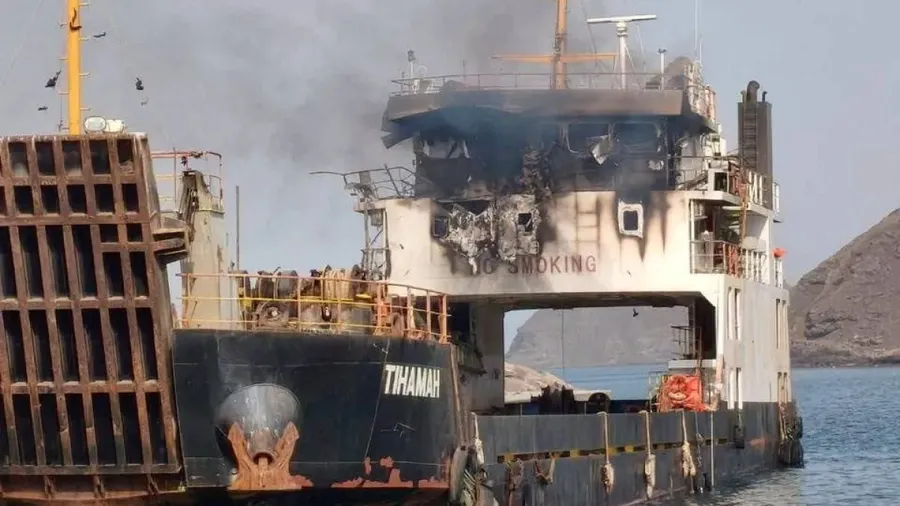
A suspected Houthi attack near Yemen’s Bab el-Mandeb Strait has left six people dead and 10 injured, bringing renewed attention to the risks facing commercial shipping in one of the world's most important maritime chokepoints.
The incident involving the Egyptian-owned cargo vessel Tihamah highlights how quickly the security environment can deteriorate for ships operating between the Red Sea and Gulf of Aden.
Cargo vessel comes under attack
Yemeni authorities said the Tihamah was struck in the Bab el-Mandeb area, with the first attack reportedly starting a fire and causing significant damage to the vessel.
Four crew members were killed in the initial strike, including three Pakistani nationals and one Indonesian national. Seven crew members were among those injured.
The vessel reportedly lost control following the attack, prompting rescue teams to move into the area.
A second strike then hit while the evacuation operation was underway, according to Yemen's Coast Guard. Two members of the National Resistance Forces involved in the rescue effort were killed, while additional personnel were injured.
The internationally recognised Yemeni government has attributed the attack to the Houthis. The group later claimed to have attacked a vessel carrying Saudi military equipment but did not specifically identify the Tihamah.
The UK Maritime Trade Operations agency separately reported that a vessel had been hit by an unknown projectile in the Bab el-Mandeb area.
Identifying the vessel
The vessel was identified as the Tihamah through analysis of photographs showing its deck and mast configuration.
Tracking data placed the ship near the Yemeni coast on August 11, after it had departed the government-controlled port of Al Mokha.
Maritime security firm Ambrey also reported an incident involving a vessel in the area and said the ship was not Saudi-owned or operated.
Shipping data indicated that Egyptian companies were listed as the vessel's owners and managers.
A wider deterioration in Red Sea traffic
The incident comes amid a broader decline in commercial shipping through the Red Sea region.
The Houthis announced a maritime embargo against Saudi Arabia on July 20, citing what they described as a Saudi blockade of Yemen. Saudi Arabia has rejected that characterisation.
Commercial traffic through the Bab el-Mandeb has already fallen significantly following years of attacks on merchant vessels.
Kpler data indicated that an average of around 32 ships per day passed through the strait during the latest reported week, compared with approximately 50 vessels per day before the latest restrictions.
For operators, fewer ships using the route does not necessarily mean lower risk. Reduced traffic can instead reflect companies diverting vessels, delaying voyages or adopting longer routes to avoid exposure.
Hormuz also seeing fewer ships
The security pressure is not limited to the Red Sea.
Traffic through the Strait of Hormuz has also declined sharply. Only six ships were recorded passing through the strait on Monday, compared with a 10-day average of around 11 vessels.
That is dramatically below the estimated 130–140 ships per day seen before the current conflict.
For global shipping, the simultaneous disruption of two major maritime chokepoints presents a particularly difficult operating environment. Route planning, war-risk assessment, insurance, crew welfare and voyage economics can all be affected.
What it means for crews and operators
For masters and crews, incidents such as this underline the importance of following the latest security guidance before entering high-risk waters. A vessel's risk profile can change rapidly, particularly when attacks occur close to established shipping lanes.
For shipowners and operators, the consequences extend beyond the immediate physical threat. Rerouting around Africa can add substantial sailing time and fuel consumption, while heightened security risks can affect insurance premiums, chartering decisions and cargo schedules.
The reported deaths also demonstrate a difficult reality for seafarers: even when a vessel is not directly involved in regional military operations, commercial ships and their crews can become exposed to the consequences.
Why this matters
- For seafarers: The incident reinforces the need for robust security procedures, voyage-specific risk assessments and reliable communication with maritime security authorities.
- For shipowners: Red Sea and Bab el-Mandeb exposure can affect routing, insurance, fuel consumption, schedules and overall voyage economics.
- For operators and charterers: Falling traffic through major chokepoints signals that alternative routing and contingency planning may remain necessary.
- For the maritime industry: Simultaneous disruption around the Bab el-Mandeb and Hormuz could have wider consequences for global trade, energy movements and vessel availability.
Conclusion
The Tihamah incident is a stark reminder that the security situation around the Red Sea remains highly fluid. For commercial shipping, the challenge is no longer simply choosing the shortest route—it is balancing safety, crew welfare, cost and operational certainty in an increasingly unpredictable maritime environment.
Source: Marine Insight
Related Articles
Deaths of Indian Seafarers Spark Demands for Greater Protection in Conflict Zones
The deaths of Indian seafarers aboard a tanker operating near Oman have triggered grief across maritime communities and renewed calls for stronger protections for civilian crews working in high-risk regions. As tensions continue to disrupt shipping in the Gulf, the incident has also intensified…
Container Freight Rates Surge as Middle East Tensions Ripple Through Global Supply Chains
The impact of the ongoing Iran conflict is being felt far beyond the Middle East. Container shipping markets are experiencing a sharp rise in freight rates as carriers grapple with higher operating costs, disrupted trade flows, and mounting congestion at key Asian transshipment hubs. With the…