REGENT’s Viceroy Seaglider Completes First Crewed Flight
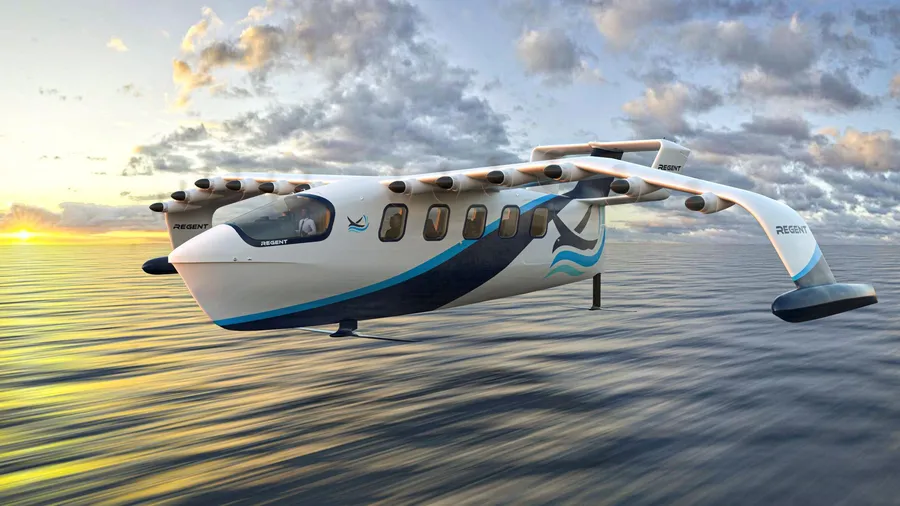
REGENT Craft has moved its Seaglider concept another step closer to commercial operations after its full-scale Viceroy prototype completed its first flight with people aboard.
The all-electric craft flew for 30 seconds over Narragansett Bay, demonstrating its transition from hydrofoil operation to wing-in-ground-effect flight—a technology that could create a new category of fast coastal transportation.
From Hull to Hydrofoil to Flight
The Viceroy is designed around three operating modes. At low speeds, it behaves like a conventional vessel, floating on its hull. As speed increases, it rises onto hydrofoils, reducing water resistance. At higher speeds, its wings lift the craft into ground-effect flight just above the water.
During its first crewed flight, the 12-passenger prototype covered 1,956 feet at approximately 33 feet above the water, remaining airborne for 30 seconds with two captains on board.
Ground effect is central to the concept. By flying within roughly one wingspan of the surface, the craft benefits from reduced aerodynamic drag, potentially allowing it to achieve high speeds with lower energy consumption than conventional aircraft.
REGENT says the production Viceroy is being designed for speeds of up to 180 mph and a range of up to 180 miles.
Despite its aircraft-like appearance and ability to fly, the Seaglider is intended to remain a maritime platform. In the United States, it is regulated as a vessel by the U.S. Coast Guard and operated by certified mariners.
A Five-Year Development Journey
The crewed flight follows approximately 18 months of testing with the full-scale prototype. REGENT gradually increased hydrofoiling speeds while combining physical sea trials with simulation-based development.
The current Viceroy prototype is approximately 55 feet long with a 65-foot wingspan. Its successful transition from hydrofoil operation into flight represents a significant test of the company's underlying concept.
REGENT began developing the technology in 2020 and demonstrated an earlier quarter-scale prototype in 2022 before unveiling the full-scale Viceroy in March 2025.
The company now considers the program to be entering the final phase of sea trials before production.
From Prototype to Production
The development program is also being supported by new manufacturing infrastructure.
In June, REGENT completed a 255,000-square-foot waterfront manufacturing facility at its Quonset, Rhode Island headquarters. The facility is planned for major production activities including assembly, wing and hydrofoil integration, battery installation, systems integration and testing.
The facility will support both the crewed Viceroy and REGENT's autonomous Squire Seaglider.
Commercial interest is already building. REGENT says its order book extends across six continents and represents several years of planned manufacturing capacity. U.S. coastal travel operator The Twenty Five has been announced as the company's first U.S. launch customer, with an order for up to 60 Viceroy Seagliders.
The technology is also being developed for defense applications, including logistics, medical evacuation and intelligence, surveillance and reconnaissance missions. REGENT has secured a $15 million contract with the U.S. Marine Corps Warfighting Laboratory, alongside a cooperative research agreement with U.S. Special Operations Command.
Its autonomous Squire demonstrator has already completed a defense-oriented ground-effect flight.
Why this matters
- A new coastal transport model: If commercial certification and reliability targets are achieved, Seagliders could offer much faster point-to-point coastal connections without requiring conventional runways.
- Maritime skills remain relevant: Unlike conventional aircraft, the Viceroy is designed around maritime operation, with certified mariners at the controls.
- Electric propulsion meets high speed: The combination of batteries, hydrofoils and ground-effect flight highlights one possible pathway toward lower-emission high-speed passenger transport.
- Ports may become part of the aviation transition: Waterfront terminals rather than airports could become the operating infrastructure for this emerging class of vehicle.
The first crewed flight does not yet make the Seaglider a commercial transport system, but it demonstrates that REGENT's transition from vessel to aircraft-like flight can work at full scale.
The next challenge is turning a successful prototype flight into a safe, certifiable and economically viable service. For the maritime industry, that transition will be worth watching closely.
Source: gCaptain
Related Articles