Louis Dreyfus Partners with Neptune Robotics to Test AI-Powered Hull Cleaning Across 300 Vessels
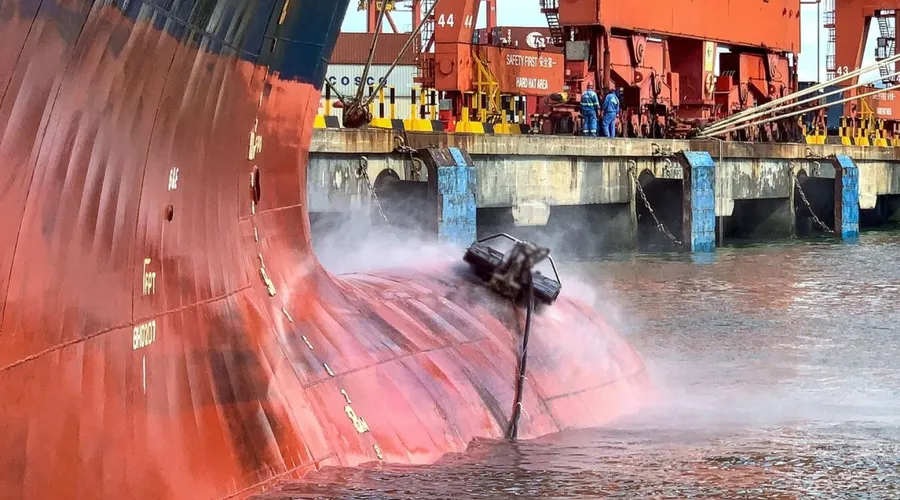
Artificial intelligence and underwater robotics are gaining ground in commercial shipping as operators look for practical ways to reduce fuel consumption and vessel emissions. Louis Dreyfus Company (LDC) has partnered with Neptune Robotics to test robotic hull-cleaning technology across a fleet of 300 chartered vessels, bringing automated underwater maintenance closer to large-scale commercial deployment.
Main Article
Dutch-French commodities multinational Louis Dreyfus Company (LDC) is joining forces with Singapore-based Neptune Robotics to evaluate AI-powered robotic hull cleaning across its chartered fleet.
Under the agreement, Neptune will deploy its robotic cleaning services on vessels chartered by LDC, with the objective of improving vessel efficiency, reducing fuel consumption and lowering associated emissions.
The initiative is being conducted under the Maritime and Port Authority of Singapore's (MPA) In-Water Hull Inspection & Cleaning Innovation Program.
LDC will make vessels available for technology trials under actual operating conditions. The findings from the programme are expected in 2028.
Robotic Technology Moves Towards Commercial Scale
The partnership marks Neptune Robotics' second major industry collaboration within three weeks. Earlier this month, the company announced a similar agreement with Cargill, one of the world's largest dry bulk operators.
The Cargill programme will run for 18 months and involve remotely operated, AI-enabled underwater vehicles performing several tasks:
- In-water hull cleaning.
- Detailed assessments of hull condition.
- Monitoring and measuring fuel consumption improvements.
- Comparing vessel performance before and after cleaning operations.
Neptune aims to demonstrate that robotic hull maintenance can deliver measurable operational benefits while reducing the need for traditional underwater cleaning methods.
How Neptune's Robots Clean Ship Hulls
Neptune's robotic systems use artificial intelligence to inspect underwater hull surfaces and identify marine growth.
The robots employ specialized cavitational waterjets to remove accumulated biofouling from the flat bottom and vertical sides of vessels.
According to the company, the technology can clean a Capesize vessel within approximately 24 hours and operate in challenging conditions, including:
- Water currents of up to four knots.
- Both clear and murky underwater environments.
- Daytime and nighttime operations.
The system is also designed to preserve existing antifouling coatings while capturing the removed marine growth, helping minimize the environmental impact of cleaning activities.
Why Hull Cleaning Matters for Fuel Efficiency
Marine biofouling remains an important operational challenge for commercial vessels.
The accumulation of algae, microorganisms and other marine organisms increases hull resistance as a ship moves through water. This can force propulsion systems to work harder, resulting in higher fuel consumption and increased emissions.
Depending on vessel characteristics and operating conditions, biofouling can increase fuel consumption by as much as 30%.
For shipowners and charterers operating large fleets, even modest improvements in hull performance can translate into meaningful fuel savings over time.
Through the LDC partnership, both companies will examine cleaning procedures, operational efficiency and the quality of performance data generated by the robotic systems.
Neptune Expands Its Global Reach
Neptune Robotics currently provides coverage across 61 ports in East Asia, reaching approximately 70% of major global trade routes.
The company also raised $52 million last year to accelerate commercial deployment, expand research and development, develop new robotic systems and strengthen its AI-based service platforms.
With partnerships involving both LDC and Cargill, Neptune is positioning robotic hull maintenance as a scalable service for large commercial shipping fleets.
Why This Matters
- For shipowners and charterers: Robotic hull cleaning could reduce underwater maintenance costs, improve vessel performance and generate long-term fuel savings.
- For chief engineers: Better hull condition monitoring provides additional information for managing propulsion efficiency, fuel consumption and maintenance schedules.
- For seafarers: Increased automation could reduce the need for certain traditional underwater cleaning operations, while creating demand for professionals familiar with digital inspection and remote-operated systems.
- For the maritime industry: AI-powered hull maintenance offers another practical route towards reducing shipping emissions without requiring immediate changes to vessel propulsion systems.
Conclusion
The collaboration between Louis Dreyfus and Neptune Robotics demonstrates how underwater robotics and artificial intelligence are moving beyond experimental applications towards large-scale commercial shipping operations.
If the trials deliver measurable fuel and efficiency improvements, robotic hull cleaning could become an increasingly important part of future vessel maintenance and emissions-reduction strategies.
Source: The Maritime Executive
Related Articles