India Targets 100 New Merchant Ships as It Pushes for Greater Shipping Independence
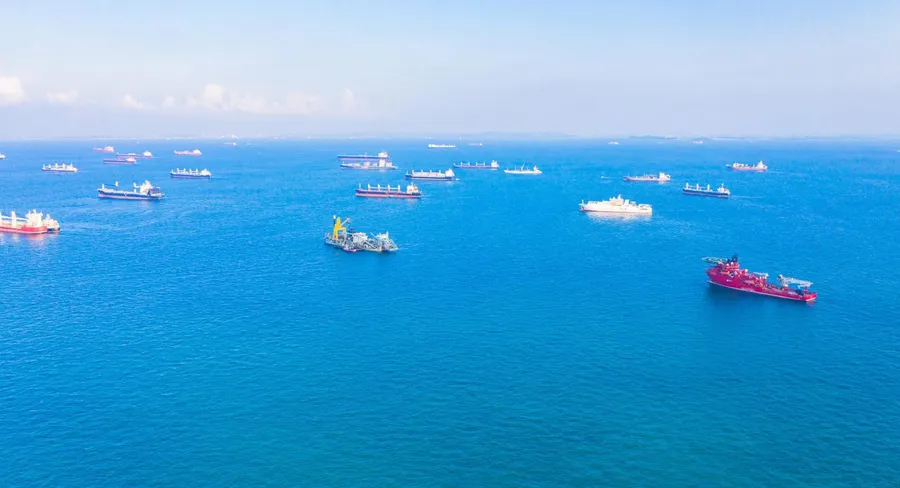
India is planning to add around 100 merchant ships to its fleet over the next five years, aiming to reduce the country’s reliance on foreign shipping companies for transporting strategic cargo.
The move combines fleet expansion with reforms in taxation, financing, shipbuilding and seafarer development.
India is looking to strengthen its position as a ship-owning nation by adding 100 merchant vessels over the next five years.
Speaking at the first Sagar Samvad, Union Minister of State for Ports, Shipping and Waterways Shantanu Thakur highlighted the scale of India's dependence on foreign shipping operators. According to figures presented at the event, India spends approximately $75 billion annually on foreign shipping companies to move essential commodities including crude oil, coal, urea and natural gas.
The government sees greater domestic ownership and control of shipping capacity as an important part of India's long-term maritime strategy.
The National Shipping Board (NSB) has proposed a five-point approach to improve the competitiveness of Indian shipping companies. Its recommendations include tax reforms, assured cargo support, simpler regulations, cheaper financing and a more business-friendly operating environment.
Cost remains a major obstacle
One of the biggest challenges for Indian shipowners is the cost of operating under the Indian flag.
Industry representatives estimate that operating an Indian-flagged vessel can be 16–20% more expensive than operating under a foreign flag. Taxes associated with ship acquisition and maintenance, deductions affecting seafarer remuneration, freight-related taxation and relatively expensive domestic financing all contribute to the difference.
The issue also affects India's Right of First Refusal (RoFR) mechanism. Under the system, Indian shipping companies can receive preference for certain cargoes, but they may need to match the freight rate offered by foreign competitors.
For an owner already carrying a higher cost base, competing purely on freight can therefore be difficult.
The NSB's proposals are intended to address these structural disadvantages and make Indian-flag shipping more commercially viable.
Fleet growth already underway
India's merchant fleet has been expanding, although the government wants the pace to increase.
Official figures presented at Sagar Samvad put the Indian fleet at roughly 1,500–1,600 vessels. One figure cited at the event was 1,544 ships, comprising 492 overseas vessels and 1,052 coastal vessels.
Indian-flag fleet capacity crossed 14.2 million gross tonnes in March 2026. During fiscal 2026, 92 vessels were added to the Indian register, representing approximately 1.584 million gross tonnes.
The government has also indicated that a further 62 vessels could be registered in fiscal 2027, potentially adding another 2.85 million gross tonnes.
At the same time, India is attempting to attract foreign-owned tonnage to its flag. Companies including CMA CGM, A.P. Moller–Maersk and Mitsui O.S.K. Lines have already reflagged vessels to India, while Hapag-Lloyd and NYK are expected to bring additional vessels under the Indian flag.
Shipping expansion linked to wider maritime ambitions
The proposed fleet expansion forms part of India's broader Maritime Amrit Kaal Vision 2047 and Maritime India Vision 2030.
Shipbuilding is another important part of the strategy. The government is providing financial support for vessel construction and assistance for establishing and developing shipyards.
India is also targeting a major increase in port infrastructure. According to Union Minister Sarbananda Sonowal, national port capacity is expected to reach 10,000 million tonnes per annum by 2047, roughly four times the existing level.
The government has additionally introduced a ₹10,000 crore Container Manufacturing Assistance Scheme, with Maersk already beginning to place orders for containers manufactured in India.
Taken together, the policies indicate that New Delhi is looking beyond simply increasing the number of ships. The broader objective is to develop an integrated maritime ecosystem covering ships, ports, shipyards, containers, financing and skilled manpower.
More ships also mean more seafarer opportunities
Fleet expansion could have a direct impact on India's maritime workforce.
Labour and Employment Minister Mansukh Mandaviya has emphasised the country's large pool of seafarers as a potential competitive advantage. The government is calling for stronger training programmes, industry-led skills development and more employment opportunities.
There is also a push to increase participation in maritime sectors where India sees future growth, including cruise shipping and advanced shipbuilding, while reducing the gender gap across maritime occupations.
For Indian seafarers, a larger domestic fleet could mean more opportunities for employment and career progression. However, the real benefit will depend on whether fleet growth is matched by quality training, modern vessels, competitive wages and strong safety standards.
Why this matters
- For Indian shipowners: Lower taxes, cheaper financing and assured cargo could make Indian-flag operations more competitive with foreign-flag alternatives.
- For seafarers: A larger Indian fleet could create additional jobs, particularly if growth extends into specialised vessels, cruise shipping and advanced shipbuilding.
- For cargo owners: Greater domestic shipping capacity could reduce India's exposure to foreign freight markets when transporting strategic commodities.
- For the maritime industry: The 100-ship target is part of a much broader attempt to build India's ship-owning, shipbuilding and port ecosystem rather than expanding fleet numbers alone.
Conclusion
India's plan to add 100 merchant ships in five years represents a significant attempt to strengthen national control over strategic maritime trade. But achieving the target will require Indian shipping to become commercially competitive, not simply larger.
If tax, financing, regulatory and skills challenges are addressed alongside fleet growth, India could substantially strengthen its position in the global maritime industry by 2047.
Source: Marine Insight
Related Articles