Greensand Puts Europe’s Offshore CO₂ Shipping Chain Into Commercial Operation
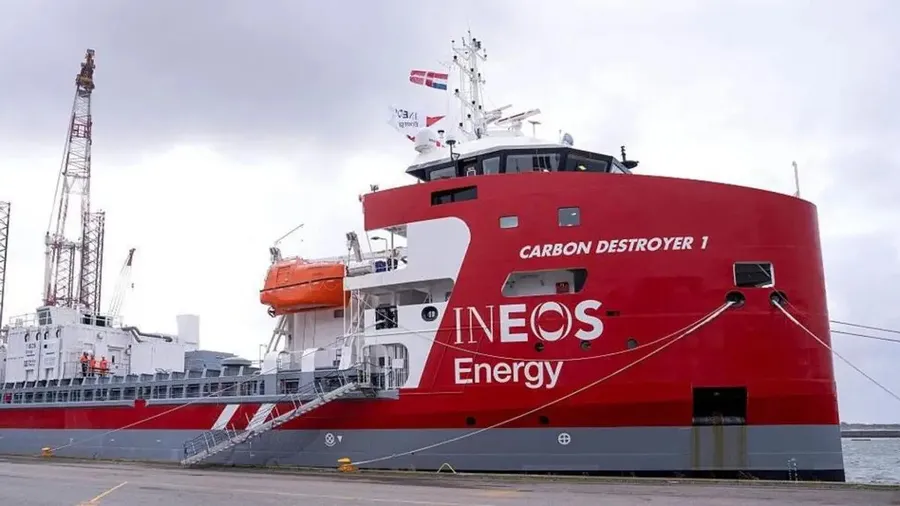
Europe has moved another step closer to building a large-scale carbon capture and storage (CCS) industry, with INEOS starting commercial operations at the Greensand project in Denmark.
The project creates an operational chain for moving captured CO₂ from industrial sources to permanent offshore storage beneath the North Sea — bringing CO₂ transport by ship into a commercial CCS system at European scale.
From factory emissions to permanent storage
Greensand is being developed by INEOS Energy, Harbour Energy and Nordsøfonden. During its initial phase, the project will primarily receive CO₂ captured from biomethane facilities in Denmark.
The captured gas is first liquefied and transported by truck to a dedicated CO₂ terminal at Port Esbjerg.
From there, the CO₂ is loaded onto Carbon Destroyer 1, described as the EU's first purpose-built CO₂ carrier. The vessel transports the liquefied CO₂ offshore before it is injected into the Nini West reservoir, a depleted oil field in the Danish sector of the North Sea.
The storage site is approximately 250 km offshore, with the CO₂ being permanently stored around 1,800 metres beneath the seabed.
For shipping, this is an important development. It demonstrates a complete logistics chain in which CO₂ moves from a capture facility, through a port and dedicated carrier, to an offshore storage site.
A relatively small start with a much larger target
Greensand's initial commercial capacity is up to 400,000 tonnes of CO₂ per year.
That is only the beginning. The project has been designed with the potential to eventually handle 4–8 million tonnes annually, depending on demand and the development of additional capture projects.
The scale-up question is particularly important because Europe's industrial CCS ambitions are significantly larger. The EU has set targets of around 50 million tonnes of annual CO₂ capture and storage capacity by 2030, increasing to approximately 250–280 million tonnes per year by 2040.
Reaching those numbers will require considerably more than storage reservoirs. Europe will need capture facilities, pipelines, liquefaction infrastructure, specialised terminals, CO₂ carriers and offshore injection capacity working together as one logistics network.
Why shipping matters to CCS
Not every industrial emitter will have a pipeline connection to an offshore storage site.
That creates an opening for maritime transport. CO₂ can potentially be liquefied, transported from different ports and delivered to shared offshore storage hubs, giving emitters greater geographic flexibility.
For shipowners and maritime technology companies, this could create a new cargo segment — but one with its own technical and regulatory requirements.
CO₂ carriers need to handle liquefied carbon dioxide under controlled pressure and temperature conditions. Ports will also require specialised loading, storage and handling infrastructure.
Greensand therefore represents more than an individual CCS project. It provides a working example of how ports, ships and offshore reservoirs can become connected components of Europe's decarbonisation infrastructure.
The next challenge is scale
The Greensand project has demonstrated that the transport-and-storage side of the CCS chain can operate commercially.
The next question is whether enough industrial emitters will invest in CO₂ capture to supply projects like Greensand at the scale required.
That will depend on a combination of regulation, carbon pricing, infrastructure investment and long-term commercial commitments between emitters, transport providers and storage operators.
For the maritime sector, the development is worth watching closely. As more European CCS projects move from planning to execution, demand could emerge for CO₂ carriers, specialised port infrastructure, storage terminals and supporting maritime services.
Why this matters
- For shipowners: CO₂ transportation could develop into a new specialised shipping segment as offshore storage capacity expands.
- For ports: CCS will require new infrastructure for liquefied CO₂ reception, temporary storage and vessel loading.
- For industrial operators: Offshore storage can provide an option for managing captured emissions even when a direct pipeline connection is impractical.
- For maritime technology providers: CO₂ logistics will create demand for specialised vessels, cargo systems, monitoring and digital infrastructure.
Greensand marks a shift from discussing CCS as a future concept to operating a complete capture-to-storage logistics chain.
The bigger test now is scale — and whether Europe's industrial and maritime infrastructure can grow quickly enough to support the continent's long-term CO₂ storage ambitions.
Source: splash247
Related Articles