CMA CGM and RSGT Commit $434 Million to Expand Jeddah’s Container Capacity
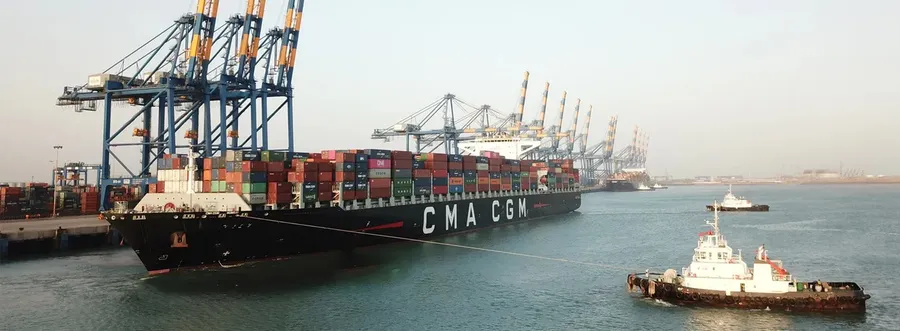
Saudi Arabia is moving ahead with another major investment in its maritime infrastructure, with CMA CGM Group and Red Sea Gateway Terminal (RSGT) committing an initial $434 million to develop a new container terminal at Jeddah Islamic Port.
The project will add up to 2.6 million TEUs of annual handling capacity, strengthening Jeddah’s role as a key gateway between Asian, European and Middle Eastern markets.
Main article
CMA CGM and RSGT have signed definitive agreements to jointly develop and operate Terminal 4 at Jeddah Islamic Port, working alongside the Saudi Ports Authority (Mawani).
The development will be incorporated into RSGT’s existing concession at the Red Sea port. The initial investment of around SAR 1.6 billion ($434 million) will be directed towards new maritime and landside infrastructure.
The planned terminal will feature deep-water berths capable of accommodating the world's largest container vessels, supported by modern cargo-handling systems and 10 new ship-to-shore cranes.
Once operational, the additional facility is expected to provide as much as 2.6 million TEUs of annual capacity.
Preparing Jeddah for larger ships and higher volumes
The expansion comes as Saudi Arabia seeks to accommodate increasing trade volumes and develop Jeddah into a more important logistics and transshipment centre.
Jeddah Islamic Port occupies a strategically important position on the Asia-Europe maritime corridor, linking major trading economies through the Red Sea.
Adding deep-water capacity will allow the port to handle newer generations of ultra-large container vessels while potentially creating room for additional international liner services.
For cargo owners, greater terminal capacity can also translate into improved connections between Saudi exporters and importers and their international markets.
Terminals becoming strategic assets for shipping lines
For CMA CGM, the agreement represents more than an investment in additional port capacity.
The French carrier has been expanding its presence in the terminal sector, with interests in 64 port terminals globally. Owning or operating terminal infrastructure gives major shipping groups greater influence over critical points in their networks.
This strategy has become increasingly relevant as shipping routes face congestion, geopolitical disruption and changing trade patterns.
Control over terminal capacity can provide carriers with greater operational flexibility and potentially improve the reliability of cargo flows across major trade lanes.
The Jeddah investment therefore fits into CMA CGM’s wider strategy of building an integrated shipping and logistics network rather than relying solely on vessel operations.
Part of Saudi Arabia’s Vision 2030 strategy
The Terminal 4 project is also aligned with Saudi Arabia's wider ambitions to become a major global logistics hub.
The country is investing heavily in ports, transport infrastructure and logistics under Vision 2030 and the National Transport and Logistics Strategy.
Jeddah is central to those plans because of its location on the Red Sea and proximity to one of the world's most important container trade corridors.
The new terminal could help Saudi Arabia capture a greater share of regional transshipment and logistics activity while strengthening connections between domestic industries and international markets.
The agreement was signed in Paris during a French-Saudi investment roundtable attended by Saudi Crown Prince Mohammed bin Salman and French President Emmanuel Macron.
What it means for shipping operations
For shipping lines, larger berths and additional cranes can improve the port's ability to process next-generation container ships efficiently.
For vessel operators and masters, the ability to accommodate larger ships at additional deep-water facilities could also influence future port rotations and service patterns.
The project will not, by itself, remove the wider operational challenges facing Red Sea shipping. However, it represents a significant long-term investment in infrastructure along a trade route that remains strategically important to global commerce.
Why this matters
- For shipping lines: Additional terminal capacity could improve scheduling flexibility and support the deployment of larger container vessels on Red Sea services.
- For cargo owners: Greater capacity at Jeddah could strengthen connections between Saudi businesses and international markets.
- For shipowners and operators: Modern deep-water infrastructure can accommodate larger vessels and potentially support more efficient port calls.
- For Saudi Arabia: The project strengthens the Kingdom's ambition to become a major international logistics and transshipment hub under Vision 2030.
Conclusion
The $434 million Terminal 4 investment reinforces Jeddah's growing importance in the global container network while giving CMA CGM a stronger presence at a strategically located Red Sea gateway.
As Saudi Arabia builds out its logistics infrastructure, Jeddah is increasingly positioning itself not simply as a national port, but as a critical link in the wider Asia-Europe supply chain.
Source: gCaptain
Related Articles