Autonomous LNG Carriers Move Closer as HD Hyundai, Avikus and ClassNK Join Forces
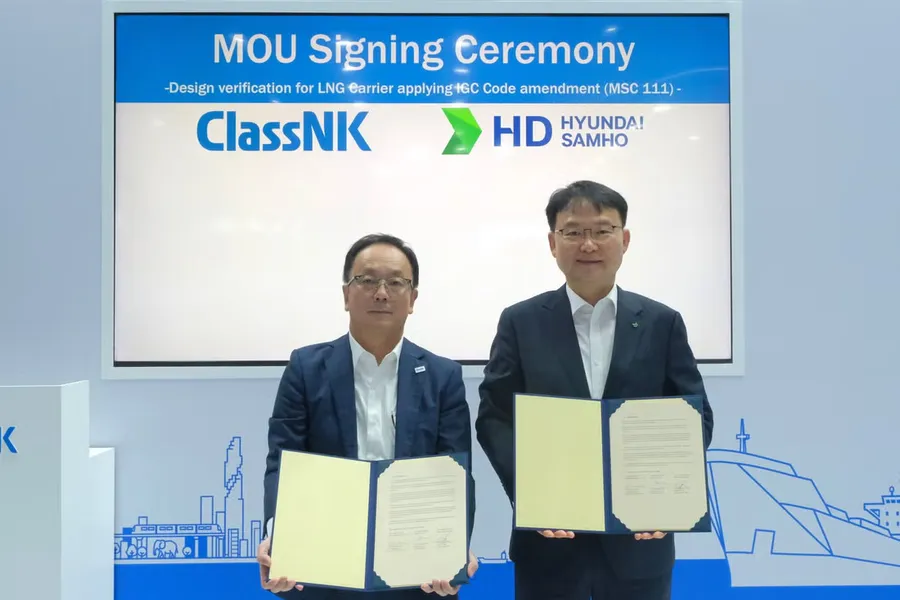
HD Hyundai Samho, autonomous-navigation specialist Avikus and classification society ClassNK are working together to bring autonomous navigation deeper into LNG carrier design.
The three companies have signed an MoU to develop and verify a vessel design incorporating autonomous navigation technology, with a 180,000 m³ LNG carrier serving as the project’s technical reference.
The agreement was signed at Gastech 2026 in Bangkok, Thailand, bringing together three different parts of the maritime technology chain: shipbuilding, autonomous systems and classification.
Designing autonomy into the ship from the start
Rather than treating autonomous navigation as an add-on, the project will examine how Avikus’ HINAS Control system can be integrated into the design of a large LNG carrier.
HD Hyundai Samho will develop the basic vessel design around the requirements of the targeted ClassNK autonomous navigation notation. Avikus will contribute its HINAS Control technology, including autonomous-navigation algorithms and system functions.
ClassNK will assess the resulting design against its Guidelines for Automated/Autonomous Operation of Ships and determine whether it satisfies the requirements for the relevant notation.
The vessel being studied is currently under construction, making the project particularly relevant to the growing question of how autonomous technologies can be incorporated into newbuilds rather than retrofitted later.
From technical design to classification
One of the key objectives is to establish whether the autonomous navigation system can meet classification requirements in an actual vessel design.
The partners intend to pursue Approval in Principle (AiP) as part of this process, creating a pathway from technology development to formal verification.
For shipowners and operators, this distinction matters. Autonomous navigation is not simply about whether software can control a vessel. Its integration also involves system reliability, safety functions, human interaction, operational procedures and compliance with classification requirements.
The project could therefore provide a practical reference for how autonomous navigation systems may be incorporated into future commercial vessels.
HINAS Control moves towards wider verification
Avikus said HINAS Control has already been adopted as a standard solution on vessels within the HD Hyundai Group. The latest project will give the technology an opportunity to be assessed against classification standards in the context of a large LNG carrier.
The companies also see the project as a potential stepping stone toward applying the technology to vessels already in operation.
For crews, autonomous navigation does not necessarily mean removing people from the operational picture. In the near term, systems such as these are more likely to change how bridge teams monitor, supervise and interact with navigation systems, particularly during routine operations.
That makes human-machine interfaces, alert management, system redundancy and crew training important considerations alongside the underlying navigation algorithms.
The collaboration also reflects a broader industry trend: autonomous shipping is increasingly moving from technology demonstrations toward classification-backed vessel designs and defined operational frameworks.
Why this matters
- For shipowners: Designing autonomy into a newbuild could provide a clearer pathway for future upgrades and operational integration.
- For seafarers: Autonomous systems are likely to change bridge workflows, increasing the importance of monitoring, supervision and human-machine interaction skills.
- For shipyards and designers: Classification requirements are becoming an important part of autonomous vessel architecture, not simply a final-stage compliance exercise.
- For the wider industry: Collaboration between shipbuilders, technology providers and class societies can help turn autonomous-navigation concepts into commercially deployable vessel designs.
The next step for autonomous shipping is increasingly about proving that the technology can work within the ship, its operational environment and the classification framework.
The HD Hyundai–Avikus–ClassNK project is another example of that transition, using a large LNG carrier as a practical platform for testing the path from autonomous technology to class-verified vessel design.
Source: Container News
Related Articles