Maersk and Lloyd’s Register Explore a ‘Pink Corridor’ for Nuclear-Powered Container Shipping
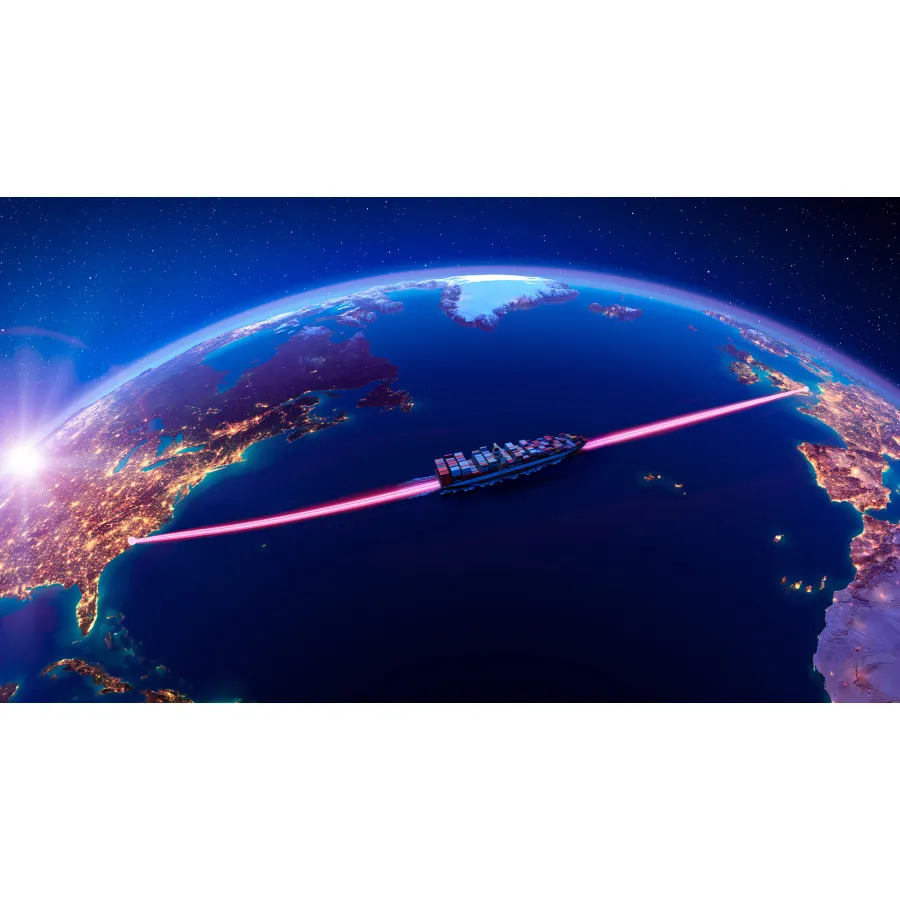
Nuclear propulsion is moving from a long-term concept toward a subject of serious industry and regulatory discussion. A new collaboration involving Lloyd’s Register, A.P. Moller–Maersk, the Port of Charleston and the Port of Felixstowe will examine what would be required to operate a theoretical nuclear-powered container service between the United States and the UK.
The initiative, known as the “Pink Corridor,” will focus less on designing a ship and more on understanding whether ports, regulators and other stakeholders could safely support nuclear-powered commercial vessels.
Testing the Requirements for a Nuclear Shipping Route
The project will use a conceptual nuclear-powered containership to examine what access to the proposed transatlantic route could look like from a security, regulatory and operational perspective.
The study will consider areas including ship security, nuclear safeguards, cybersecurity, emergency response, insurance and regulatory coordination.
That last point is particularly important. A nuclear merchant vessel would operate at the intersection of two regulatory environments—maritime and nuclear. Developing a workable framework would require both sides to understand their respective responsibilities and how those requirements interact at sea and in port.
The project is intended to identify practical gaps rather than suggest that nuclear-powered container ships are ready for immediate commercial deployment.
Why Nuclear Propulsion Is Back on the Agenda
Commercial nuclear shipping is not a new idea.
Several nuclear-powered maritime projects were explored during the 1950s and 1960s. The United States developed the NS Savannah as a demonstration of civilian nuclear propulsion, while Japan also conducted experiments with nuclear-powered shipping. The Soviet Union's Sevmorput, a nuclear-powered cargo vessel, remains an example of the technology being used commercially.
The renewed interest is being driven by advances in small modular and advanced nuclear reactor technologies, alongside growing pressure to reduce emissions from deep-sea shipping.
Nuclear propulsion could potentially provide vessels with long operating endurance without the need for conventional marine fuels. However, questions surrounding safety, regulation, port acceptance, security, financing and insurance remain significant barriers.
Ports Are Central to the Challenge
The involvement of Charleston and Felixstowe highlights an important reality: nuclear shipping is not only a vessel-design problem.
Even if a reactor-powered containership could be engineered and certified, it would still need permission to enter ports, berth, load and discharge cargo, receive support and respond to emergencies.
Ports would therefore need appropriate security arrangements, emergency procedures, trained personnel and regulatory coordination.
The Pink Corridor provides a framework for examining those requirements along a specific theoretical route rather than treating nuclear shipping as an abstract global concept.
Part of Wider US-UK Nuclear Maritime Cooperation
The initiative also aligns with broader US-UK efforts to explore civilian nuclear applications in maritime transportation.
The work builds on a 2024 regulatory assessment by Lloyd’s Register and Core Power, followed by a joint development project involving Maersk that examined the safety, operational and regulatory implications of advanced nuclear propulsion for container ships.
The wider US maritime sector is also showing increasing interest. The U.S. Maritime Administration has entered into agreements exploring nuclear-powered commercial vessels and nuclear-related port initiatives, including work involving the Port of Long Beach and Port of Corpus Christi.
For the Pink Corridor, the first phase is expected to establish the major areas requiring further investigation. A possible second phase could expand into engineering, legislation, regulation, security and nuclear safeguards for future merchant vessels.
Why this matters
- Ports could become the biggest regulatory hurdle: Nuclear-powered ships would require ports to develop procedures and capabilities well beyond those used for conventional vessels.
- Maritime and nuclear regulation must work together: Classification, flag states, port authorities and nuclear regulators would need clearly defined responsibilities.
- Nuclear propulsion could reshape long-haul shipping: If advanced reactors become commercially viable, ships could potentially operate for extended periods without conventional bunkering.
- The industry is moving from theory toward practical questions: Projects such as the Pink Corridor are beginning to examine what would actually be required before nuclear merchant shipping could become operational.
The Pink Corridor does not represent the launch of a nuclear-powered container route. Instead, it is an attempt to understand the real-world barriers between today's regulations and tomorrow's potential nuclear merchant fleet.
For shipowners, ports and regulators, that groundwork may prove just as important as the reactor technology itself.
Source: The Maritime Executive
Related Articles