EUKOR Completes First Green Methanol Bunkering
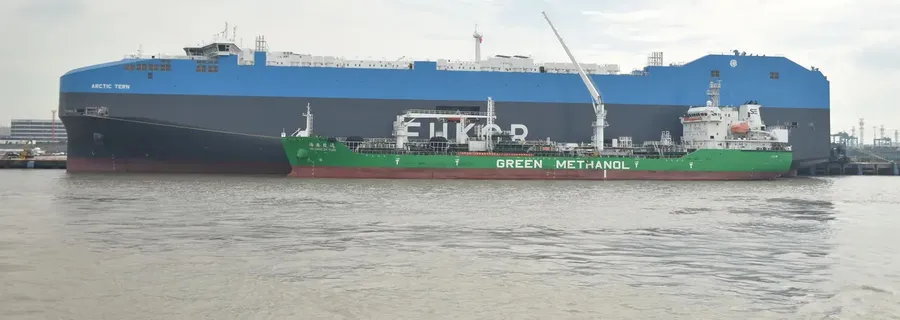
EUKOR’s Arctic Tern Completes First Green Methanol Bunkering at Shanghai
The transition to low-carbon shipping reached another milestone as EUKOR Car Carriers completed the first green methanol bunkering of its newest pure car and truck carrier (PCTC), Arctic Tern, at the Port of Shanghai. The operation highlights how collaboration across the fuel supply chain is helping alternative marine fuels move from concept to commercial reality.
EUKOR Car Carriers, SIPG Energy, and World Fuel have successfully completed the maiden green methanol bunkering of M/V Arctic Tern, the first vessel in the new Shaper Class series of car carriers, at the Port of Shanghai.
Around 2,800 metric tonnes of ISCC-EU certified green methanol were supplied to the vessel through a ship-to-ship (STS) transfer using M/V Hai Gang Zhi Yuan, SIPG Energy's dedicated methanol bunkering vessel and currently the largest of its kind in operation. The bunkering took place at the Haitong Terminal in Shanghai's Waigaoqiao Port Area, while cargo operations continued simultaneously, demonstrating the efficiency of conducting bunkering and cargo handling at the same time.
The operation marks several important firsts. It is EUKOR Car Carriers' first green methanol bunkering, the first methanol refuelling for Arctic Tern since its delivery on 9 July, and the first time an international PCTC operator has received green methanol produced locally in Shanghai.
The fuel was produced from municipal solid waste, carries ISCC-EU certification, and has a carbon intensity of less than 25 gCO₂e/MJ, reinforcing its credentials as a lower-emission marine fuel.
World Fuel coordinated the fuel procurement and delivery on behalf of EUKOR, while SIPG Energy served as the physical supplier at the Port of Shanghai. Together, the companies demonstrated Shanghai's growing capability to support an integrated green methanol supply chain—from local production and storage to bunkering—creating what stakeholders describe as a scalable model for future operations.
Arctic Tern is the first of 14 methanol dual-fuel Shaper Class vessels ordered by Wallenius Wilhelmsen. Designed to carry 9,300 car equivalent units (CEUs), the vessel will be operated by EUKOR Car Carriers, a joint venture between Wallenius Wilhelmsen and Hyundai Motor Group.
Following the successful bunkering operation, the vessel has resumed its maiden voyage on the Asia-Europe trade route.
Company executives described the operation as a significant step toward making alternative fuels commercially practical. They noted that combining next-generation vessel technology with reliable fuel availability demonstrates that green methanol can increasingly support everyday shipping operations rather than isolated pilot projects.
SIPG Energy also highlighted that the operation set a new record for the largest single simultaneous-operation (SIMOPS) green methanol bunkering of a PCTC in China, further strengthening Shanghai's ambitions to become a global hub for green marine energy.
Why This Matters
- For shipowners: Reliable green methanol bunkering infrastructure is expanding, making it easier to operate dual-fuel vessels on major international trade routes.
- For ports: Shanghai's integrated production, storage, and bunkering network demonstrates how ports can support the industry's transition to alternative fuels.
- For operators: Conducting bunkering alongside cargo operations reduces turnaround time and improves operational efficiency.
- For maritime decarbonization: The project shows that certified low-carbon fuels are steadily moving into mainstream commercial shipping, supported by cooperation between shipowners, fuel suppliers, and ports.
Conclusion
The successful bunkering of Arctic Tern reflects the rapid progress being made in green methanol adoption across the automotive shipping sector. As fuel availability and port infrastructure continue to improve, alternative fuels are becoming an increasingly practical option for reducing shipping's carbon footprint without compromising operational efficiency
Related Articles