From Major Disasters to Everyday Mistakes: The Safety Lessons Repeating at Sea
The latest review of marine casualties by the US National Transportation Safety Board (NTSB) points to a familiar problem in shipping: serious accidents often begin with ordinary failures that appear manageable at the time.
The NTSB’s Safer Seas Digest 2025 examines 49 marine casualty investigations, ranging from major ship accidents and fires to collisions, groundings, flooding and machinery failures. Together, the cases highlight recurring weaknesses in maintenance, watchkeeping, emergency preparedness and operational discipline.
The headline casualties
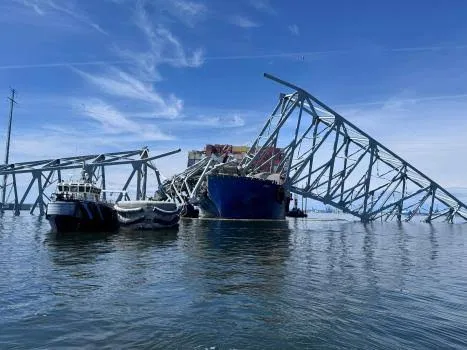
Among the most significant cases is the March 2024 Dali casualty, when the containership lost electrical power and struck Baltimore’s Francis Scott Key Bridge. The subsequent bridge collapse killed six construction workers.
The investigation resulted in nearly two dozen safety recommendations, including urgent measures concerning bridges over navigable waterways where the risks associated with impacts from large oceangoing vessels had not been adequately assessed.
The digest also revisits the 2023 Titan submersible disaster, in which all five people aboard died during a dive to the Titanic wreck.
According to the NTSB investigation, shortcomings in the operator's engineering process meant the submersible did not meet necessary strength and durability requirements. Investigators also identified inadequate testing and deficiencies in emergency-response planning.
Another major case involved the 2023 fire aboard Grande Costa D’Avorio at Port Newark, New Jersey. Two firefighters died and six other emergency responders were injured.
The NTSB found that shore-based firefighters did not have adequate procedures or training for dealing with a vessel fire. The resulting response was ineffective and contributed to the fire spreading. The investigation produced 11 safety recommendations.
The bigger picture is in the smaller incidents
The value of the NTSB review is not limited to high-profile disasters.
Across the 49 investigations, investigators repeatedly encountered problems involving maintenance, voyage planning, fire detection and containment, watertight integrity, fatigue, distraction, lithium-ion batteries, electrical failures and emergency preparedness.
Other risks included heavy weather, strong currents and equipment or machinery not being operated as intended.
Fixed-object contacts represented the largest category, accounting for 16 investigations. Fires and explosions followed with 11 cases, while groundings or strandings accounted for seven. Five investigations each involved collisions and flooding or hull failures.
These numbers reinforce an important operational point: safety failures are not confined to unusual or extreme scenarios.
When routine lapses become casualties
One example involved the fishing vessel Papa Rod, which collided with the anchored bulk carrier Appaloosa in May 2024.
The watchstander fell asleep while the vessel was underway on autopilot. The vessel did not have a watch alarm capable of waking the operator or alerting other crew members.
Another case on the Lower Mississippi River involved towing vessel William B Klunk and its 22-barge tow.
The pilot became distracted by mobile-phone use before the tow struck moored barges near Baton Rouge. Investigators found that the pilot had been looking at the phone approximately 40 seconds before the collision and had made no rudder or throttle adjustments during the preceding minutes.
Fatigue was also a factor. The pilot had obtained only around four hours of continuous sleep over the previous 36 hours and had been awake for almost 18 hours at the time of the accident.
A watertight door with serious consequences
The yacht Lovebug provides another reminder of how seemingly minor conditions can undermine vessel safety.
The vessel developed a heavy list and partially sank in Chesapeake Bay. Investigators found no hull breach, but salvors discovered a partially open stern garage door and an open watertight door leading toward the engine room.
The NTSB concluded that undetected flooding through the open watertight door caused the vessel to lose stability.
For crews, this is a familiar principle: watertight integrity is only effective when doors, hatches and other openings are actually secured and monitored as required.
Safety is built into the ordinary watch
The common thread running through these investigations is not a single piece of equipment or one particular type of vessel.
It is the gap between procedures and what actually happens during operations.
A maintenance item can be overlooked. A watchkeeper can become distracted. A watertight door can remain open. An emergency plan can exist on paper but fail during a real incident.
The NTSB's Safer Seas Digest 2025 brings these cases together with probable causes and lessons learned, providing a useful reference for operators and crews looking beyond individual accidents to identify recurring patterns.
Why this matters
- For seafarers: Fatigue, distraction, watchkeeping and basic procedural discipline remain critical safety barriers, even with increasingly automated vessels.
- For shipowners and operators: Maintenance systems, emergency drills and operating procedures need to work in practice—not simply satisfy documentation requirements.
- For safety managers: Repeated casualty patterns can provide useful indicators for reviewing SMS procedures, bridge/engine-room practices and crew training.
- For maritime technology companies: Automation, alarms and monitoring systems can strengthen safety, but their effectiveness depends on correct design, maintenance and human interaction.
The most useful lesson from casualty investigations is often not what went wrong in an extraordinary situation, but which ordinary barrier failed first.
For ships and crews, preventing the next major casualty may depend on getting those everyday details right—before they become an emergency.
Source: gCaptain
Related Articles

Containers Crash onto Bunker Vessel During Cargo Operations in Antwerp
Accidents Containers Crash onto Bunker Vessel During Cargo Operations in Antwerp Incident Highlights Risks of Simultaneous Cargo Handling and Bunkering Activities A routine cargo operation
Ukraine Strikes Russian Oil Pipeline Hub as Global Energy Supply Tightens
As tensions disrupt shipping in the Strait of Hormuz, another blow has hit global energy logistics. Ukraine has targeted a key Russian oil pipeline facility linked to Black Sea export terminals, potentially affecting crude flows from one of Russia’s major export routes.
Training Gap Exposed After Tanker–Trawler Collision Sinks Fishing Vessel in Firth of Clyde
A routine afternoon in Scottish coastal waters ended with a trawler on the seabed and three fishermen in a liferaft.The UK’s Marine Accident Investigation Branch (MAIB) has now concluded that the collision between the crude oil tanker Apache and the stern trawler Serinah was not just a navigational…
29 Dead in Basilan Ferry Sinking as Philippines Grounds Operator’s Entire Fleet
A routine inter-island voyage turned fatal in the early hours of January 26, when a roll-on/roll-off ferry capsized off Basilan in the southern Philippines.With 29 lives lost and a history of prior incidents linked to the operator, authorities have taken the rare step of suspending the company’s…