Back
China Shifts Soybean Buying Back to Brazil After Meeting U.S. Trade Target
China has fulfilled its short-term commitment to buy U.S. soybeans — and is now pivoting back to cheaper Brazilian supply.
For bulk shipping and commodity traders, the shift highlights how price spreads and geopolitics continue to steer cargo flows.
Trade Commitments Met — Margins Take Over
Over the past three months, China has imported roughly 12 million tons of U.S. soybeans, satisfying a shipment commitment outlined by Washington in November under a renewed trade understanding.
With that benchmark reached, Chinese buyers have stepped up purchases from Brazil.
In the past week alone, importers booked at least 25 Brazilian soybean cargoes, primarily for March and April loading, according to market participants. At the same time, Chinese state-owned firms have reportedly paused fresh U.S. purchases.
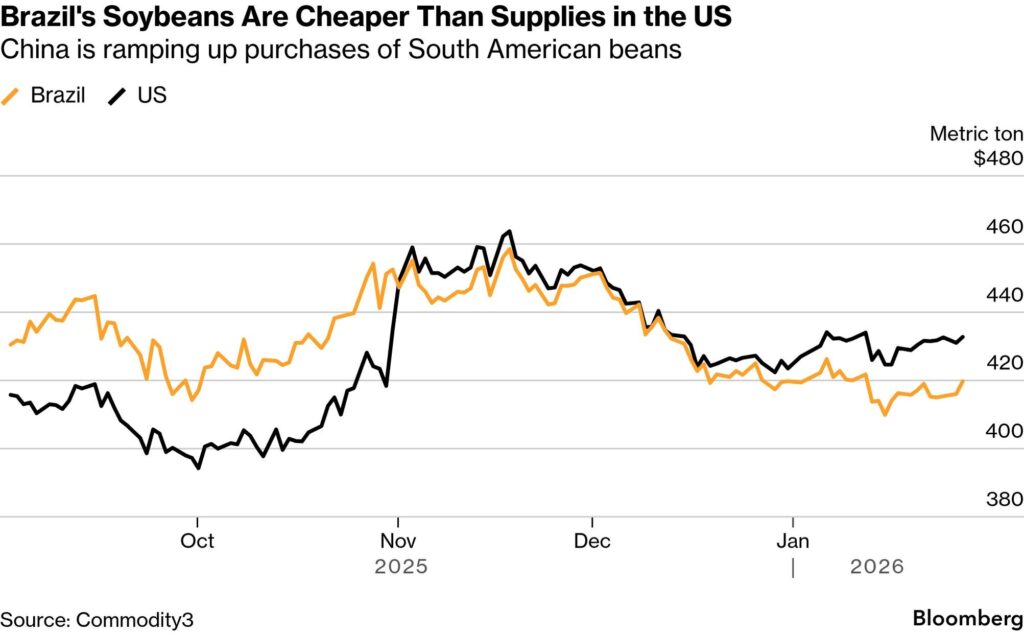
The driver appears straightforward: Brazilian soybeans are currently cheaper.
Delivered U.S. cargoes on a cost-and-freight basis are trading at a significant premium to comparable Brazilian shipments for February arrival. For Chinese crushers, processing U.S. beans at current prices would mean operating at a loss.
In a margin-sensitive sector, that calculation matters.
Long-Term Commitments Still in Place
Despite the current shift, the broader framework remains intact.
The United States has indicated that China committed to purchasing at least 25 million tons of U.S. soybeans annually through 2028. While Beijing has not formally confirmed the target, it has already:
• Reduced certain tariffs
• Lifted import bans on three American exporters
However, U.S. soybeans still face tariffs of around 13%, according to traders. Further reductions may be necessary before private Chinese crushers re-enter the U.S. market in larger volumes.
Some analysts suggest that China could still meet longer-term commitments — even if it temporarily prioritizes cheaper origins — by managing reserves and adjusting procurement timing over the next three years.
Brazil’s Supply Advantage
Brazil is benefiting from strong agricultural conditions.
Favorable weather during the peak growing season has led the U.S. Department of Agriculture to raise its forecast for Brazil’s soybean harvest to a new record. Ample supply naturally weighs on prices, enhancing Brazil’s competitiveness.
Shipping schedules indicate that Brazil’s export pace to China in coming months is broadly consistent with prior seasons. In other words, China has not scaled back Brazilian business despite improving U.S. relations.
For now, economics are winning over diplomacy.
U.S. Logistics Face Winter Headwinds
A Familiar Pattern in Commodity Trade
Soybeans have long been a sensitive pressure point in U.S.–China relations. During earlier trade tensions, China sharply reduced American purchases before resuming buying under negotiated agreements.
The current shift suggests a pragmatic strategy:
1. Meet political commitments.
2. Then optimize on price and margin.
For commodity shipping, this means trade lanes can pivot quickly — even when headline diplomacy suggests stability.
Why This Matters
• For bulk shipowners: Brazil–China routes remain strong, supporting ton-mile demand even as U.S.–China volumes fluctuate.
• For charterers and operators: Price spreads and weather disruptions can rapidly reshape cargo origins and voyage planning.
• For traders and agri-businesses: Crushing margins, tariffs, and freight costs are now as influential as political agreements.
• For maritime professionals: Agricultural commodities remain deeply intertwined with geopolitics — but in the short term, economics still drive vessel employment.
China’s soybean strategy illustrates a core truth of global trade: commitments may set the framework, but freight flows ultimately follow price.


China Shifts Soybean Buying Back to Brazil After Meeting U.S. Trade Target

29 Dead in Basilan Ferry Sinking as Philippines Grounds Operator’s Entire Fleet

Maersk Tankers Installs First Suction Sails in Major Wind Retrofit Push

Russian Crude Builds at Sea as Indian Refiners Dial Back Purchases