Maersk Tankers Installs First Suction Sails in Major Wind Retrofit Push
Wind propulsion is no longer a concept study — it’s now bolted onto tanker decks. Maersk Tankers has completed the first installation in a five-vessel retrofit program with bound4blue, signaling that wind-assisted propulsion is entering mainstream tanker operations.
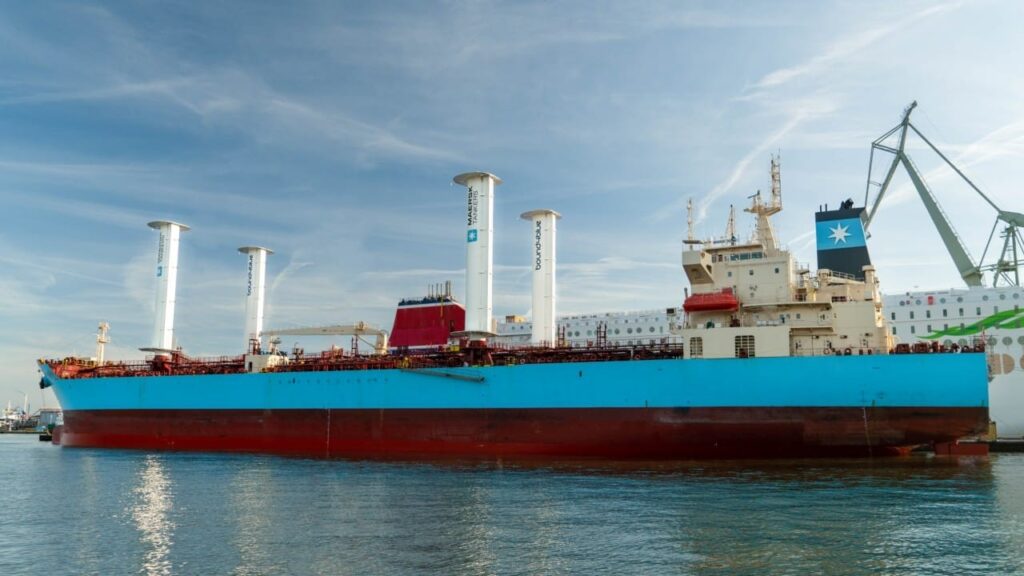
Four 24-Meter Suction Sails Installed on Maersk Trieste
The medium-range tanker Maersk Trieste is now equipped with four 24-metre eSAIL suction sails, marking the first completed installation under a December 2024 agreement between Maersk Tankers and Spanish wind propulsion specialist bound4blue. The broader contract covers 20 eSAIL units across five MR tankers, making it bound4blue’s largest order to date. Installation was carried out at EDR Shipyard in Belgium, following preparatory modifications completed earlier at Yiu Lian Shipyard in Shenzhen, China. That work included fitting deck pedestals and upgrading electrical systems to support the sails. The final integration used a pre-commissioned plug-and-play approach, allowing the sails to be lifted into position and connected with minimal downtime — a critical factor for commercially active tankers.
Designed for Tanker Conditions
Installing wind systems on tankers presents additional challenges due to ATEX-regulated hazardous areas. According to bound4blue, the project demonstrates that its eSAIL technology can be deployed safely and efficiently within such environments.
Unlike traditional rigid sails, eSAIL units generate thrust using suction. Air is drawn across an aerodynamic surface, creating lift and forward propulsion. The system operates autonomously and adjusts to wind conditions without constant crew intervention.
The company states that vessels can achieve double-digit percentage reductions in fuel consumption and CO₂ emissions, alongside improvements in Carbon Intensity Indicator (CII) performance.
For operators navigating tightening emissions frameworks, these gains are commercially meaningful.
Regulatory and Commercial Drivers
Wind-assisted propulsion is increasingly linked to compliance strategy rather than branding. The eSAIL systems can contribute toward performance targets under: • FuelEU Maritime • EU Emissions Trading System (EU ETS) • Wind Reward Factor provisions • EEDI and EEXI requirements For Maersk Tankers, the decision reflects a broader push to combine operational efficiency with regulatory readiness. The remaining four vessels in the program are expected to follow as part of the fleet-level rollout.
Wind Moves Beyond Pilot Projects
This installation builds on a growing list of bound4blue agreements with owners such as Louis Dreyfus Company, Eastern Pacific Shipping, Odfjell, Klaveness Combination Carriers, and BW Epic Kosan. The pattern is clear: wind propulsion is shifting from isolated trials to scaled deployment — including on technically complex vessel types like product tankers. For an industry facing both fuel price volatility and decarbonization pressure, auxiliary wind power is being evaluated as a practical efficiency layer rather than an experimental add-on.
Why This Matters
• For shipowners: Fleet-scale wind retrofits are now commercially viable, with measurable fuel savings and compliance advantages. • For chief engineers and crews: Plug-and-play installation and autonomous operation reduce onboard complexity while supporting emissions targets. • For operators and charterers: Wind-assisted propulsion can improve CII ratings and reduce exposure to FuelEU and EU ETS costs. • For the wider market: Tanker adoption signals that wind propulsion is moving into mainstream commercial shipping — not just bulkers and niche segments.
The message from this installation is straightforward: wind is becoming part of the propulsion mix. For modern fleets, efficiency gains may increasingly come not only from engines and fuels — but from the air above the deck.