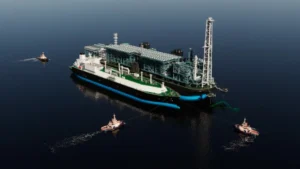
Titan Wind Energy has secured a major contract to build the hull of a new floating production, storage and offloading (FPSO) vessel, marking another step into the offshore energy infrastructure market.
The Chinese company disclosed in a stock exchange filing that the contract is valued at approximately 568 million yuan (around $83.6 million). The order was placed by China Merchants Heavy Industry, one of China’s leading offshore and shipbuilding groups.
According to project details, the FPSO hull will measure approximately 199.2 meters in length, with a beam of 41 meters and a depth of nearly 23 meters. Construction is expected to be completed in 2027.
Once delivered, the vessel will be owned by a subsidiary of Singapore-based OceanSTAR Elite, a company actively expanding its presence in the offshore production sector.
While the final deployment location has not been officially confirmed, industry attention is focused on Malaysia’s offshore sector. The new FPSO could potentially support Petronas’ Sepat Integrated Redevelopment Project, a key initiative aimed at extending production from mature offshore assets.
The speculation follows an agreement signed earlier this year between OceanSTAR and Petronas. Under the long-term contract, OceanSTAR will provide the lease, operation, and maintenance of an FPSO while also managing the engineering, procurement, construction, installation, and commissioning of a newly built unit and its associated topside facilities.
The contract reflects a broader trend in offshore energy, where operators are increasingly turning to FPSOs to develop and redevelop fields without the need for extensive fixed platform infrastructure. These vessels offer flexibility, reduced development timelines, and the ability to operate in remote offshore environments.
The development also comes at a sensitive moment for the industry. Over the weekend, a serious accident occurred on the floating storage and offloading (FSO) unit currently operating at the Sepat field. Three workers lost their lives after a lifeboat reportedly detached during maintenance activities and fell into the sea. Another worker sustained serious injuries.
While the incident is unrelated to the new FPSO project, it serves as a reminder that safety remains a critical priority across offshore operations, from vessel construction and commissioning through to long-term field production.