China’s Autonomous Feeder Nails First Fully Automated Berthing
Autonomous shipping has just crossed another operational milestone.
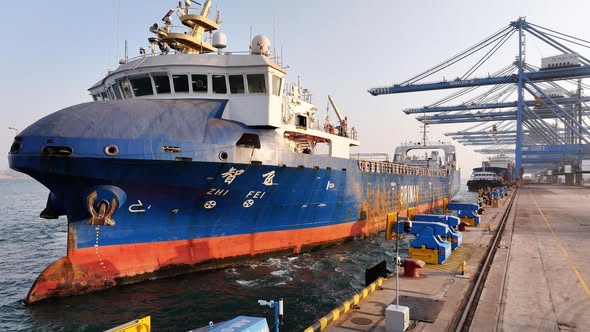
A 300 TEU electric feeder in China has completed its first fully autonomous docking and cargo-handling cycle—bringing unmanned vessel operations one step closer to routine port reality.
From Smart Sailing to Smart Berthing
The vessel Zhi Fei, operated by Navigation Brilliance (BRINAV), entered commercial service in April 2022. At 110 meters in length, the ship was designed with three operating modes: conventional crew navigation, shore-based remote control, and fully unmanned autonomous sailing.
On February 21, at Qingdao Port’s terminal in Shandong Province, Zhi Fei demonstrated something new: a complete autonomous approach and berthing sequence.
Using onboard navigation systems, the vessel aligned itself alongside the berth. It was then secured using a vacuum-based automated mooring system that adhered to the hull—effectively replacing traditional line handling. According to reports, the entire docking process took just 30 seconds.
But the automation didn’t stop there.
The berth is also equipped for autonomous cargo operations, with cranes and trucks coordinated digitally to handle loading and discharge without conventional manual intervention.
For operators watching closely, this wasn’t just about a smart ship. It was about a smart ship working inside a smart port.
Operational Performance So Far
Zhi Fei runs between Qingdao Port and Dongjiakou, covering routes of up to 89 nautical miles at speeds of up to 12 knots.
In 2025 alone, the vessel completed 353 voyages and moved more than 80,800 TEU. Since entering service, it has sailed over 48,000 nautical miles and reportedly executed more than one million autonomous system decisions.
BRINAV states that the ship operates with 30% fewer crew than a conventional feeder, reduces the risk of human error by 80%, and saves approximately $27,500 per month in operating costs.
For short-sea and feeder networks, those are numbers that demand attention.
Technology Built Under Constraints
One of the more notable aspects of the project is how it addressed technical limitations.
With foreign radar brands unavailable, the company developed domestic radar solutions. Engineers introduced wave-suppression algorithms to filter erroneous signals caused by interference and improve data reliability.
They also worked to enhance radar measurement accuracy and expand 5G base station coverage to maintain stable ship-to-shore connectivity.
To support communications infrastructure, BRINAV collaborated with China Telecom, China Mobile, and China Unicom to optimize antenna positioning and strengthen network performance along the route.
Autonomy at sea, it turns out, is as much about telecom engineering as it is about naval architecture.
Beyond the Headlines
According to company leadership, intelligent shipping is not about eliminating people, but about increasing safety and efficiency.
That distinction matters.
Even in reduced numbers, crew remain central to oversight, contingency management, and regulatory compliance. What changes is the division of tasks—routine operations shift to algorithms, while humans move toward supervision and exception handling.
For chief engineers, deck officers, and port operators, the implication is clear: automation is becoming embedded not just in vessels, but in entire maritime ecosystems.
Why This Matters
Port-Vessel Integration Is Accelerating True autonomy requires both smart ships and smart terminals. This demonstration shows that end-to-end automation is technically achievable.
Crew Roles Are Evolving, Not Disappearing Reduced crewing models may expand in short-sea trades, but skilled oversight and systems management will remain essential.
Cost and Efficiency Pressures Are Driving Adoption Monthly operating savings and shorter berthing times directly impact feeder margins in competitive regional trades.
Connectivity Is Now Mission-Critical Infrastructure Reliable 5G and advanced sensor systems are becoming as important as propulsion and hull design in next-generation vessels.
Autonomous docking in 30 seconds may sound futuristic.
But for operators watching fuel costs, crew availability, and port congestion, it signals something more practical: automation is shifting from pilot projects to commercially deployed reality.