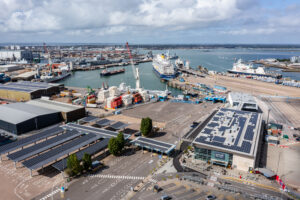
Training Gap Exposed After Tanker–Trawler Collision Sinks Fishing Vessel in Firth of Clyde
A routine afternoon in Scottish coastal waters ended with a trawler on the seabed and three fishermen in a liferaft.
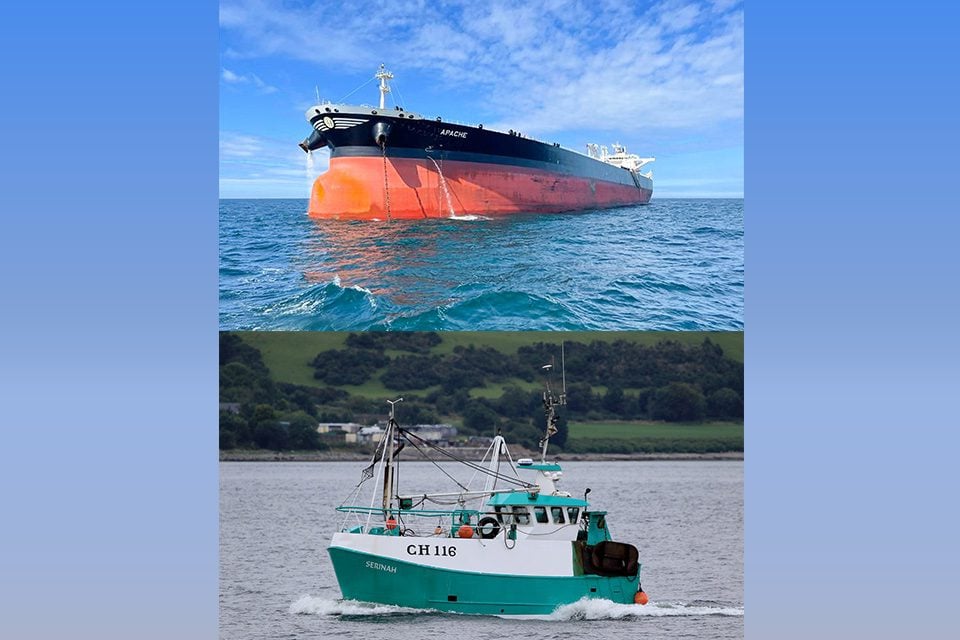
The UK’s Marine Accident Investigation Branch (MAIB) has now concluded that the collision between the crude oil tanker Apache and the stern trawler Serinah was not just a navigational failure — it was a training failure. And the regulator wants mandatory navigation training introduced for small fishing vessel crews.
What happened
On 25 April 2024, shortly after 1500 hours, Apache collided with Serinah in the Firth of Clyde.
The trawler was conducting circular fishing tows in a seabed depression, operating with gear deployed — a condition that made her restricted in her ability to manoeuvre under the International Regulations for Preventing Collisions at Sea (IRPCS).
As the vessels converged, the tanker was the give-way vessel. But according to the MAIB report, Apache’s bridge team expected the fishing vessel to alter course, relying on past experience rather than confirmed action.
No decisive avoiding manoeuvre followed.
When the tanker’s bow ran over Serinah’s towing wires, the consequences escalated quickly. The trawler developed a heavy list and sank rapidly. The three crew abandoned ship. Two managed to deploy and board an inflatable liferaft. The skipper spent approximately 15 minutes in the water before being rescued.
All survived.
Initially, Apache continued toward its pilot boarding station at Finnart Oil Terminal. It only returned after a reminder from Belfast Coastguard about its obligation to render assistance.
What investigators found
The MAIB’s findings were direct.
Neither vessel took sufficient action to prevent the collision, despite clear responsibilities under IRPCS.
Critically, investigators discovered that Serinah’s crew had received no formal navigation training. This meant they were not fully aware of their collision-avoidance obligations or able to properly assess the developing risk.
Chief Inspector Andrew Moll OBE stated the outcome could easily have been worse and highlighted navigational shortcomings on both vessels.
On board the tanker, assumptions about the trawler’s intentions delayed action. On board the trawler, limited manoeuvrability and late recognition of danger left little time for meaningful evasive steps.
In short: both crews waited too long.
The regulatory response
The MAIB has issued three safety recommendations:
The UK Maritime and Coastguard Agency (MCA) has been urged to mandate approved navigation training for skippers and watchkeepers on UK fishing vessels between 7 and 16.5 metres.
Apache’s manager, Nereus Shipping S.A., has been advised to improve fleet-wide understanding of fishing vessel operating patterns.
Serinah’s operator, S & B Fish (Agency) Limited, has been told to ensure watchkeepers are properly trained and familiar with IRPCS.
Since the incident, Nereus Shipping has audited navigational procedures across its fleet and introduced updated training and bridge practices.
Peel Ports Group has also announced plans to enhance monitoring capabilities at Clyde Port to full vessel traffic service (VTS) standards.
A wider issue beneath the surface
This case highlights a structural weakness in the UK’s safety framework: while training requirements exist for fishermen, they do not always ensure that those standing navigational watches are formally qualified in collision regulations.
That gap becomes critical in congested waters where commercial tankers and small fishing vessels operate side by side.
For bridge teams on large vessels, fishing traffic is often seen as unpredictable. For fishermen, commercial ships can appear constrained by draft or traffic lanes. When assumptions replace clear, early action, the margin disappears quickly.
This was not a technology failure. It was a human one.
Why This Matters
For fishing vessel operators: Formal navigation training may soon become mandatory. Compliance will not just be regulatory — it could be the difference between recovery and tragedy.
For tanker and merchant ship bridge teams: Assumptions about fishing vessel behaviour are a recurring risk factor. Early, decisive action under IRPCS remains essential.
For maritime regulators: The case exposes inconsistencies between certification frameworks and real-world watchkeeping competence.
For seafarers across sectors: Collision regulations only work when both sides understand them. Shared waters demand shared standards.
The Firth of Clyde collision is a reminder that even in clear conditions and familiar waters, complacency can be costly.
Training is not paperwork. At sea, it is survival.